
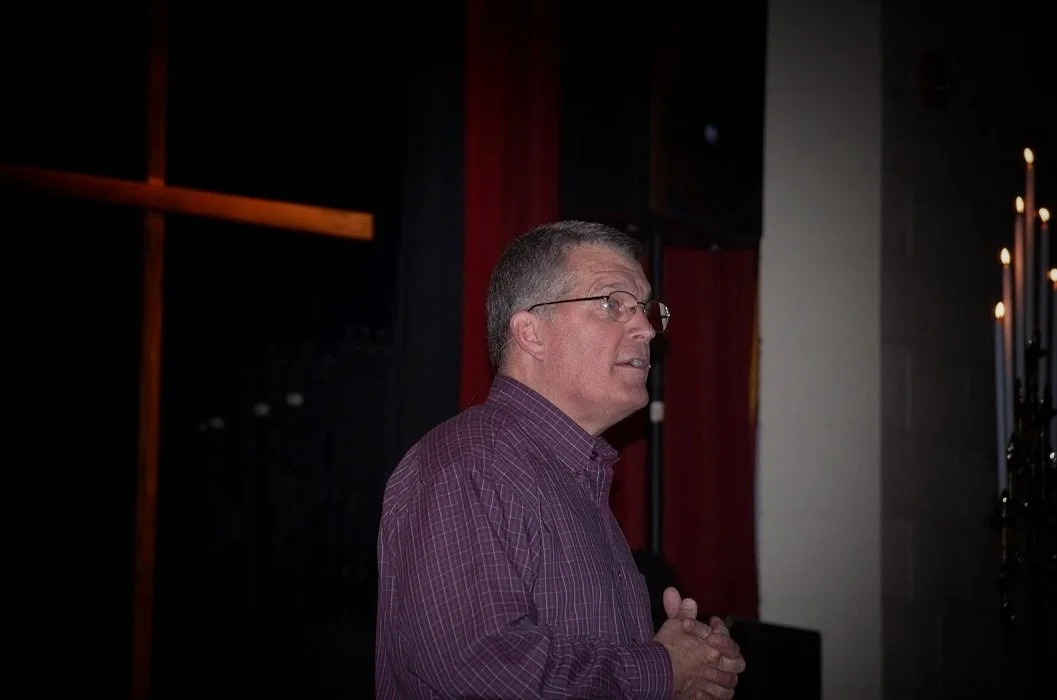
The Fear of the Lord - Various Proverbs - July 26, 2026 - David Tyrrell
/David Tyrrell opens by anchoring the entire Book of Proverbs on two foundational verses — Proverbs 1:7 and Proverbs 9:10 — which together declare that the fear of the Lord is the beginning of both knowledge and wisdom. He is careful to point out that "beginning" here doesn't mean a first step you leave behind. Rather, it's the foundation stone on which everything else rests. Like stopping at multiple overlooks along the Blue Ridge Parkway to see the same landscape from different angles, David takes three distinct stops through Proverbs to show that the fear of the Lord is life-giving, intentional, and affectional.
On the first stop, David draws from Proverbs 14:27 — "The fear of the Lord is a fountain of life, that one may turn away from the snares of death" — and traces this truth through the stories of Adam and Eve, Joseph, and Israel at Mount Sinai. In each case, the fear of the Lord was meant to guard God's people from destruction and keep them on the path of blessing. He pushes back against the idea that the New Covenant does away with this fear, pointing to John falling as though dead before the glorified Christ in Revelation 1, and to Hebrews 12:28-29, which calls believers to "offer to God acceptable worship with reverence and awe, for our God is a consuming fire."
On his second and third stops, David emphasizes that the fear of the Lord must be intentionally pursued — not assumed or passively received — and that it must flow from the heart, not merely from rule-keeping. Using Proverbs 1:29, he shows that those who reject wisdom are described as those who "hated knowledge and did not choose the fear of the Lord," revealing that the fear of the Lord is both a choice and a deep affection. He closes by pointing to Jesus as the one who perfectly embodies the fear of the Lord (Isa. 11:1-3), and to Jeremiah 32:39-41, where God promises to put his fear in the hearts of his people — not as a burden, but as a gift that causes him to "rejoice in doing them good."
Transcript
Well, good morning. It's good to be with you guys this morning and to worship with you. As Pastor Doster said earlier, I have the great privilege, the great privilege of my life, the greatest earthly privilege of my life to be married to Caroline Byrd Terrell. And when I first visited here, it was probably about 12 years ago, and. And the church was meeting in a school auditorium.
And it's been a minute, but I think I've been at least an annual attender for the last 12 years or so. And, you know, when I showed up for the first time, I was just hoping and praying that Caroline Bird would become Caroline Tarrell. And she was very gracious. The Lord was very gracious to make that happen. And Pastor Doster did our wedding for us just a little bit over 11 years ago now.
And so I'm thankful for the ways the saints in this church have been used of the Lord to strengthen and spur on Caroline over the years before I even ever met her. And so it's good to be with you today and to open God's word. So this morning, we're going to look at kind of the foundation stone of Proverbs. We're not going to be in any one place, but we're going to take the fear of the Lord, a foundation stone of the book, and we're just going to take a couple stops through the Book of Proverbs to look at the fear of the Lord. And so before we jump into it, just let me pray for us once more, and we will go from there.
Father, we thank you that we can gather in the name of your Son, with your Holy Spirit with us here. We thank you that you have given us your word so that we might behold you and see you. And so, Lord, as we just sang, we ask once more, would you help us to see your glory? Would you help us to see your wisdom? Would you strengthen our fear of you and refresh us in the fear of you that like our Lord Jesus, we might grow?
That our delight would be in the fear of the Lord. We ask it in his name. Amen. So two verses before we start our journey on the fear of the Lord. And.
And the first is Proverbs 1:7. And these two verses just help us see that the fear of the Lord really is foundational to what we have in the Book of Proverbs. So turn to Proverbs 1:7. I know a passage you were in just a number of weeks ago, but let's just read it afresh.
"The fear of The Lord is the beginning of knowledge. Fools despise wisdom and instruction." - Proverbs 1:7
And we find a similar statement. You don't have to turn there, but if you want, it's Proverbs 9:10.
"The fear of the Lord is the beginning of wisdom, and the knowledge of the Holy One is insight." - Proverbs 9:10
And so in these two verses at the beginning and end of the first section of the book of Proverbs, we see the fear of the Lord and knowledge of the Holy One set in parallel. To know God is to fear the Lord, to fear the Lord, you can't know him without fearing Him. And until you have a proper fear of the Lord, we don't really know him. So this, Solomon says, is the beginning. The fear of the Lord is the beginning.
And when he says it's the beginning, he doesn't mean, it's just, you know, you have this process. Step one, step two, step three. The fear of the Lord's not just step one. And then you move on to more important things. It's the beginning in the sense of a fountain, in the sense of a foundation stone, in the sense of a building where the fear of the Lord is foundational, and everything from there rests on the fear of the Lord.
And then he's gonna go all throughout the Book of Proverbs to talk about how the fear of the Lord should shape every nook and cranny of our lives. Bruce Watke writes this:
"What the Alphabet is to reading notes, to reading music, numerals to mathematics. That's what the fear of the Lord is to attaining the revealed knowledge of Proverbs. It's the foundation that the structure rests on” (Bruce K. Waltke, The Book of Proverbs Chapters 1-15, NICOT [Grand Rapids: Eerdmans, 2005], 181).
"It is that affectionate reverence by which the child of God bends himself humbly, carefully to his Father's law. He sees God's wrath as so bitter and his love too sweet, that hence springs an earnest desire to please him. And because of the danger of coming short from his own weakness and temptations, a holy fear, anxious care and watchfulness that he might not sin against him. This enters into every exercise of the mind, every object of life” (Charles Bridges, An Exposition of the Book of Proverbs [New York: 1847], 3).
And that's what we get in the book of Proverbs.
Everything from when you sit down to eat with a ruler to when you find honey, eat so much as is good for you, but not too much, because otherwise you'll vomit it up. Everything about every part of life. How to live in the fear of the Lord. Well, that's our first point. The fear of the Lord is life giving.
And then we took a little survey of the landscape. These next two will be shorter and just. In Proverbs, the second is the fear of the Lord is intentional. Why did Solomon write Proverbs if the fear of the Lord was static? You either have it or you don't.
Then you really would just need to push for some kind of turning point. Decision.
But the fear of the Lord is something we intentionally seek, cultivate, maintain and grow in for all of life, for every aspect of life, and until the day we die. Just listen to these words from the opening lines of Proverbs. It's to give wisdom and instruction, to give prudence to the simple, knowledge and discretion to the youth. And it's not just for the simple, but for those who are wise. Let the wise hear and increase and learning.
The fear of the Lord is intentional. It's to be intentionally sought and it's to be intentionally cultivated. Let's look at Proverbs 1, verse 20. Let's just look at these words of intentionality and choice.
"Here Wisdom cries aloud in the street. In the Markets she raises her voice. At the head of the noisy streets, she cries out. At the entrance of the city gates she speaks. How long, O simple ones, will you love being simple? How long will scoffers delight in their scoffing and fools hate knowledge? If you turn at my reproof, behold, I will pour out my spirit on you. I will make my words known to you." - Proverbs 1:20-23
Wisdom is in the streets. She's in the Market.
She's where people are at. And she's not whispering. She's not being just real quiet in the corner. She's yelling, she's shouting. She's trying to get the attention of those who do not have wisdom.
Here's a passionate plea from Wisdom to turn and embrace wisdom. Solomon wrote this book to teach us wisdom. The fear of the Lord is intentional. It's something that we need to cultivate. And then look down at chapter 1, verse 24.
How does wisdom talk about it when they don't listen?
"Because I have called and you refused to listen, have stretched out my hand and no one has heeded. Because you have ignored all my counsel and would have none of my reproof." - Proverbs 1:24-25
Then go down to verse 29.
"Because they hated knowledge and did not choose the fear of the Lord." - Proverbs 1:29
There's a dire warning.
There's a call to pursue the fear of the Lord. To intentionally, consciously, deliberately embrace the fear of the Lord.
There's also hope. Because wisdom calls out to those who don't have wisdom and says, turn. Turn now at my reproof, and if you do, I will pour out my spirit on you.
Turning isn't the end, it's the beginning. Just like when we turn to Jesus when we turn from sin, we repent and we embrace the Lord Jesus by faith, it's not the end. It's the beginning of our walk with him. And if you go through the Book of Proverbs, you find calls to this intentional pursuit. If you were to read through even the first five verses of chapter two, you see words like receive my words, treasure up my commands, make your ear attentive, incline your heart, call out for insight, seek it like silver, search for it like gold.
So the fear of the Lord is intentional. Are you intentional in your cultivation of the fear of God? Not every moment in life is a Mount Sinai moment. Most of life isn't. Most of life is in the weights and balances, the honey and the sitting down to eat and all the things of Proverbs.
And so we have to be intentional to cultivate a fear of God all throughout our lives.
Do you mind the Scriptures with confidence that there's treasure here? That there's going to be a reawakening of your wonder and fear of God when you give yourself to the Word, and a fear that if you neglect this Word, you can be confident no television show, no community program is going to do the work that only God's Word will do of instilling his fear in you. So we're in July, almost at the end of July. Maybe you started January with a Bible reading plan, a commitment to be in the Scriptures regularly. How's that going at this point in the year?
Do you need to recommit to an intentional rhythm of being in the Word to refresh and renew your fear of the Lord day by day? In the months that remain in 2026, do we see the fear of the Lord as just? Well, I'm either in it or I'm not. And as long as I call myself a Christian and I have some fear of the Lord, then I'm good. Or do we have a hunger for what Paul prays for the Philippians when he says, I'm praying that you'd be pure and blameless and for the day of Christ filled with the fruit of righteousness that comes through Jesus Christ to the glory and praise of God.
And that only goes because their love abounds more and more with knowledge and all discernment. They grow in their wisdom, and that enables their love to grow and that enables them to then choose what is pleasing to God in life so that they then bear more and more fruit for the glory of God and for their great joy. The fear of the Lord is intentional.
Let's look at one more verse on this. Proverbs 23:17.
"Let not your heart envy Sinners, but continue in the fear of the Lord all the day." - Proverbs 23:17
This tells us what we've just been saying about the fear of the Lord. It requires cultivation and continuance. Let not your heart envy sinners. It tells us that those who fear the Lord are going to feel a draw to envy sinners.
Those who are walking in the path of the fear of the Lord are going to feel a pull that maybe it actually was better. Maybe the serpent was right. Maybe the fleeting pleasures of sin would make my life more enjoyable. But Solomon says, but continue in the fear of the Lord. It's intentional at the beginning, it's intentional all throughout.
It's intentional both to cultivate and to continue in.
Well, finally, the fear of the Lord. It involves a proper fear. It is life giving. It is intentional. And the fear of the Lord is affectional.
It involves a proper love.
If the fear of the Lord was just a body of knowledge, just a set of propositions, we could say, I just need to keep these rules and I've got the fear of the Lord. I mean, think of the ultimate rule keepers in the Scriptures, the Pharisees. These guys knew how to keep rules. They were great rule keepers. But do you know what Jesus called them?
He called them hypocrites. And he quoted from Isaiah where he says, their fear of me is commandments made by men. What they called the fear of God was just commandments made by men. It has to come from the heart, otherwise all the rule keeping in the world is no good. So go to Proverbs 1:7.
We're going to look at two passages in Proverbs on this last point. The fear of the Lord is affectional. And the first One is Proverbs 1:7. We'll go back to where we started.
"The fear of the Lord is the beginning of knowledge. Fools despise wisdom and instruction." - Proverbs 1:7
And I'll just say a note that you've probably heard repeated over the weeks, and if so that's okay because it's worth bearing repeating. But as you go through Proverbs and the Psalms and you go through Hebrew poetry, parallelism is a, is a Mark of all of these verses. It's a. It's a hallmark of Hebrew poetry.
And so you want to ask yourself, when you come to these verses is the first half and the second half, how do they relate to each other? Do they complement each other? Does line B fill out and complement line A? Or do they contrast? So here we have a contrast.
The fear of the Lord is the beginning of knowledge. What's the contrast, fools despise wisdom and instruction. And it's quite a loaded term. Fools despise wisdom and instruction. It's a heart term.
It's not a. Fools just aren't smart enough to get wisdom and instruction. Fools just didn't work hard enough in school. They're just not disciplined enough. No, they actually find it repulsive.
Now, here in your area, the mosquitoes look kind of cute and small, but in South Texas, they're a little bigger and they're a little scary. And I don't think I've ever been swarmed by mosquitoes until one July day we first moved to South Texas and I couldn't make it to the car. I just had to give up at even trying to hit them all. It just made it. But.
But supposedly mosquito repellent is supposed to work. I also also read an article that said that some mosquitoes had developed an attraction for deet. So I don't know where these mosquitoes are coming from, but apparently there's bad strands of mosquitoes. But presumably when you put on mosquito repellent, it should work. If you spray yourself off, you shouldn't get bitten by mosquitoes.
They should not want you. They should smell you and go, no, thank you. Doesn't always work that way. But that's unfortunately the way fools treat wisdom and instruction. It's a repellent.
They don't want it. They find it repulsive. They despise it down to the heart.
Fools despise wisdom and instruction. Now, we read these verses, but if you scan down to verse 22, you see this language again.
"How long, O simple ones, will you love being simple? How long will scoffers delight in their scoffing and fools hate knowledge?" - Proverbs 1:22
You see that language of the heart is the fear of the Lord something you need to choose? Yes, but it's something you need to love more than that. Look at verse 29 again of chapter 1.
"Because they hated knowledge and did not choose the fear of the Lord," - Proverbs 1:29
They go together because they hated knowledge and did not choose the fear of the Lord. Wisdom is saying, there's coming a time when those who she stands in the Market and cries.
But when those who refuse to hear, there comes a time when it will be too late. One more passage on this point. Proverbs 8:13.
"The fear of the Lord is hatred of evil, pride and arrogance, and the way of evil and perverted speech." - Proverbs 8:13
I hate when you talk about some affectional language, some heart language. The fear of the Lord is hatred of evil. It's not a very popular thing to call yourself a hater in these days. But those who love God must be haters of evil. They must resist and be repulsed by the very thing that the world holds out with the lust of the flesh and the lust of the eyes and the boasting in life.
The fear of the Lord is the hatred of evil. You cannot fear God without hating evil. Have you ever heard someone say, and maybe you've said it yourself at times, oh, there's this, there's this so and so over here. And they used to walk with the Lord, and they're still a Christian because they still believe, they're just not living it. Oh, they're still a Christian, but they're just walking in sin?
Well, no, the fear of the Lord is to hate evil. The fear of the Lord, the holiness of God brings a separation between what is not of the Lord and what is of the Lord. And anyone who does not hate evil should have no confidence that they fear the Lord.
Proverbs 8, 13. We see that the fear of the Lord is diametrically opposed to evil. You know, believers and unbelievers both sin, but believers hate their sin. And the more we grow in the fear of the Lord, the more we are repulsed by our own sin and the more we relish in the grace of God that picks us back up and says, do not fear. As one Puritan author said:
"until sin is bitter, Christ cannot be sweet."
But the more we go and tasting his goodness, the more bitter sin is to us and the more sweet his grace grows. The fear of the Lord is the hatred of evil. Pride, arrogance and the evil way and perverted speech. Do I hate.
What does it mean to hate pride? The picture that came to my mind when I thought about this was a picture of pride. It was the Pharisee standing afar off. And there's the publican over there, the tax collector. And the Pharisee says, oh, God, I thank you that I'm not like other men, extortioners, unjust.
Not like this tax collector over here. You know, I fast twice a week. And he gives God the resume of his good deeds.
Wisdom hates evil. The fear of the Lord is to hate evil. And it starts with pride, starts not with the world out there, but our own overinflated view of ourselves. And the opposite of that pride is, I want God's name to be made much of. I want Jesus name to be exalted.
I want to find myself in his shadow.
It's what John the Baptist says when he says, he must increase and I must decrease. But what do we see here? The fear of the Lord is affectional. What do we take from this? Well, first we should remember and we should remind ourselves.
And we should remind our good, upstanding citizens around us who don't know Jesus, but are good, moral members of society that following rules and doing things the right way is not enough to be right with God. We must fear him. We must turn from our sin and embrace the Lord Jesus and humble ourselves and recognize that he alone is the way, the truth, and the life. That he alone can save us from our sins. Unless worship flows from the heart, it's not honoring to the Lord.
Unless the fear of the Lord flows from the heart, it's not the true fear of the Lord. But the problem is that none of us were born with this fear. We were born with lots of fears, but we were not born with the fear of the Lord. In fact, we were born like the child who just walks out into the street ready to get hit by a car. When it comes to spiritual things, when it comes to the fear of God, that's the way our natural state was and the natural state of those around us who do not fear the Lord.
But that's why Jesus came. That's why he died on the cross. To pay the penalty for our sins and to show us through his death on that cross the horror of what sin is so that we might fear the Lord Jesus is the wisdom of God pitching his tent among us. And here's how Isaiah described him 700 years before he was born. This is Isaiah 11:
"There shall come forth a shoot from the stump of Jesse. A branch from its roots shall bear fruit. The Spirit of the Lord shall rest upon him. The Spirit of wisdom and understanding, the Spirit of counsel and might. The Spirit of knowledge and the fear of the Lord. And his delight shall be in the fear of the Lord" - Isaiah 11:1-3
Jesus. He embodies God's wisdom. And his delight is in the fear of the Lord. And he didn't just come to pardon our sins through his death on the cross. He came to put the fear of God inside us.
A proper, holy reverence for God that would guard us and keep us on the path of life. Listen to what Jeremiah says:
"I will give them one heart and one way that they may fear me forever. For their own good and the good of their children. After them, I will make with them an everlasting covenant that I will not turn away from doing good to them. And I will put the fear of me in their hearts that they may not turn from me. I will rejoice in doing them good. And I will plant them in this land in faithfulness with all my heart, with all my soul." - Jeremiah 32:39-41
God says he will rejoice in doing good to the people in whom he puts his fear. Have you experienced this fear?
Do you know something of the fear of the Lord?
If not, turn and weighty wisdom says she will pour out her spirit on you so you will know the fear of the Lord. And brothers and sisters, you say, yes, I know the fear of the Lord. I've tasted this. But I am and I flow. And sometimes I am amazed at God's goodness.
And sometimes I'm just numb and dry. Continue to cultivate the fear of the Lord that it may guard you on the path of life, that it may keep you and that you too, like Jesus, may delight in the fear of the Lord. Let's pray.
Father, we are so weak. We need you, Lord. As the hymn writer says, prone to wander. Lord, I feel it. Lord, we need your fear to guard us.
We need your fear to delight us. Would you help us that, like Jesus, we would delight in the fear of you and his name?