
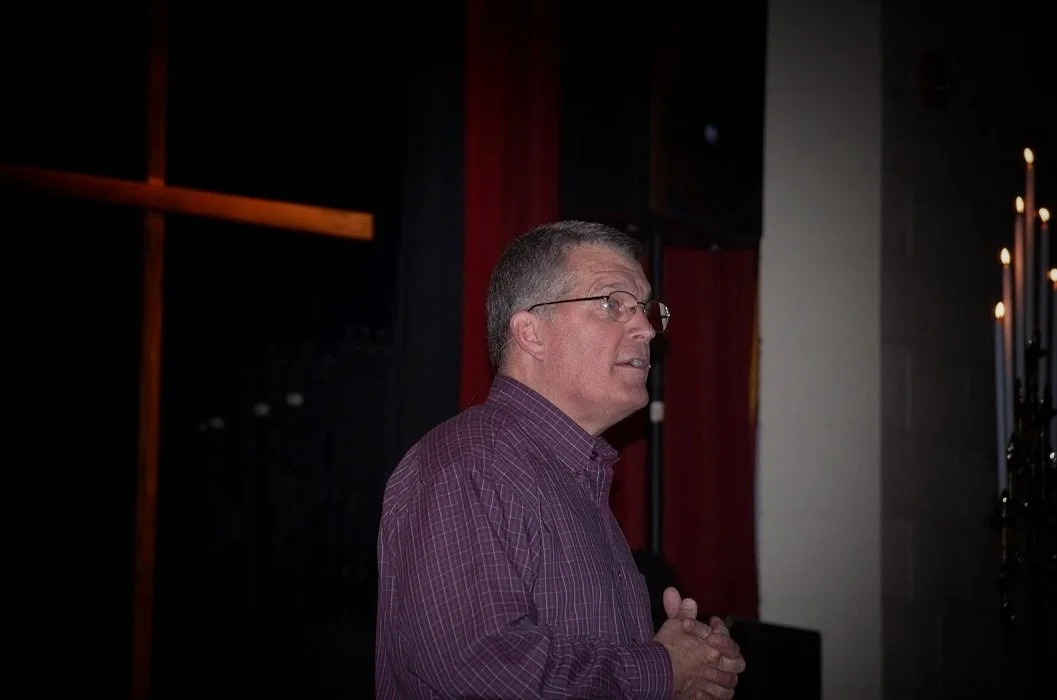
Surely I am more Stupid than any man - Proverbs 30 - July 19, 2026 - David Keyes
/David Keyes opens by admitting he wasn't exactly eager to preach, and that Proverbs isn't the easiest book to tackle — he describes it as "shoving a bunch of wives' sayings in a cannon, pointing it at a piece of vellum and shooting it." But Proverbs 30 stopped him in his tracks, largely because of its unusual author, Agur, and his disarming opening confession in Proverbs 30:2: "Surely I am more stupid than any man." David calls this "comparative stupidity" — not self-loathing, but an honest reckoning with the vast distance between human understanding and the infinite wisdom of God. Just as Job came to the end of himself in Job 42:1-6 and repented in dust and ashes, Agur begins from a place of genuine humility, recognizing that all wisdom flows downward from God, not upward from man.
The heart of the message lands on Proverbs 30:4, where Agur asks a series of rhetorical questions — who has ascended to heaven and come down, who has gathered the wind in his fists, what is his name, and what is his Son's name? David argues these questions, whether Agur fully understood it or not, point unmistakably to Christ. Jesus himself answers in John 3:13, "No one has ascended into heaven except he who descended from heaven, the Son of Man." God did not wait for us to climb up to Him; He came down to us, because we had no capacity to make that journey on our own.
The remainder of the chapter, filled with Agur's quirky observations about leeches, lizards in Kings' palaces, and the wisdom of ants, reflects a man who learned by paying careful attention to God's creation. David summarizes Agur's method simply: observe what is dangerous, what is mysterious, what causes disorder, what is wise, and what is noble. The closing exhortation — "pressing anger produces strife" (Proverbs 30:33) — is Agur's final, almost humorous reminder to put your hand over your mouth before you say something foolish. Wisdom, David concludes, is a cycle: the more you truly know, the more you realize how much you don't know, and that growing awareness is itself a Mark of growing in God.
Transcript
Proverbs, chapter 30.
"The man declares, I am weary, O God. I am weary, O God, and worn out. Surely I am too stupid to be a man. I have not the understanding of a man. I have not learned wisdom, nor have I knowledge of the Holy One, who has ascended to heaven and come down, who has gathered the wind in his fists, who has wrapped up the waters in a garment, who has established all the ends of the earth. What is his name? And what is his Son's name? Surely you know. Every word of God proves true. He is a shield to those who take refuge in him. Do not add to his words, lest he rebuke you and you be found a liar. Two things I ask of you. Deny them not to me before I die. Remove far from me falsehood and lying. Give me neither poverty nor riches. Feed me with the food that is needful for me, lest I be fool and deny you and say, who is the Lord? Or lest I be poor and steal and profane the name of my God. Do not slander a servant to his master, lest he curse you and you be held guilty. There are those who curse their fathers and do not bless their mothers. There are those who are clean in their own eyes, but are not washed of their filth. There are those how lofty are their eyes, how high their eyelids lift. There are those whose teeth are swords, whose fangs are knives to devour the poor from off the earth, the needy from among mankind. The leech has two daughters. Give and give. Three things are never satisfied. Four. Never say enough. Sheol the barren womb, the land never satisfied with water, and the fire that never says enough. The eye that mocks a father and scorns to obey a mother will be picked out by the ravens of the valley and eaten by the vultures through. 3 Things are too wonderful for me. 4. I do not understand. The way of an eagle in the sky, the way of a serpent on a rock, the way of a ship on the high seas, and the way of a man with a virgin. This is the way of an adulteress. She eats and wipes her mouth and says, I have done no wrong. Under three things the earth trembles. Under four it cannot bear up a slave when he becomes king, and a fool when he is filled with food. An unloved woman when she gets a husband, and a maidservant when she displaces her mistress. Four things on earth are small, but they are exceedingly wise. The ants are a people not strong, yet they provide their food in the summer. The rock badgers are A people not mighty, yet they make their homes in the cliffs. The locusts have no king, yet all of them march in rank. The lizard you can take in your hands, yet it is in Kings palaces. Three things are stately in their tread. Four. Four are stately in their stride. The lion, which is mightiest among beasts and does not turn back before any. The strutting rooster, the he goat. And a king whose army is with him. If you have been foolish exalting yourself, or if you have been devising evil, put your hand on your mouth. For pressing milk produces curds, pressing the nose produces blood, and pressing anger produces strife." - Proverbs 30:1-33
Good morning. For those of you who don't know me, my name is David Keyes, and I have to confess up front that when Pastor Doster approached me about the possibility of preaching, I was less than enthusiastic. This is not a familiar context for me, and I feel like my gifting is more related to teaching, not preaching. And so when he asked me about it, he said, well, you know, you can preach your favorite proverb. And I'm like, I don't have a favorite proverb. So I didn't say an outright no. I told him, you know, I'd do the spiritual thing and pray about it, you know, for. I said no. And so I did. I prayed about it, and I figured, you know, kind of due diligence. I would at least read through the Proverbs to see if anything kind of stuck out to me. And I don't know if y' all know this, but Proverbs is not easy to preach on. Ben did a masterful job last week in a way that I cannot do.
Most times, the type of preaching that we do here is expositional, expository preaching. And that kind of means you go verse by verse. You look at it in the smaller context and larger context, you know, it's all hermeneutics. And I took hermeneutics, and I understand that, but you can't do that with Proverbs. Proverbs is like, if you want to imagine it, it's like shoving a bunch of wise sayings in a cannon, pointing it at a piece of vellum and shooting it. It's like, splattered, and then just writing Proverbs across the top of it. And so they're not typically related. There's 400 plus Proverbs just kind of stuck out there. So trying to do that expositorily, you know, I. I'm not really familiar with preaching anyway, so preaching in a way that's thematic. Like, Ben had to do last week, you know, that's even farther removed from my comfort zone.
And so again, you know, I was praying, you know, asking God. I felt like, I don't know if y' all ever heard the story of the guy who's in a flood and he's on his roof and he's praying to God to save him. And God sends a canoe, and he says, no, I'm waiting for God to save me. He sends a motorboat. No, I'm waiting for God to save me. He finally sends a helicopter. No, I'm waiting for God to save me. And then the guy drowns, goes up, asks God, you know, how come you didn't save me? He said, I sent you a canoe, motorboat and helicopter. That was kind of me. I was looking for my own particular answer, not the one necessary God would have for me. So I'm reading through all this Proverbs, and I, you know, I was home free because I got to 29. And all of this, you know, all of what I just talked about is, is those first Proverbs. And I actually, I like Proverbs 1 through 9. I like that Solomon has characterized wisdom as a woman, and then it also a woman of the temptress, you know, that goes the other way. And I think that's all cool. But the rest of The Psalms from 10 all the way to 29 are all that other kind of just. Just little pithy bits of saying flung out there. So I thought it was home free. You know, I got through 29, and then I came to chapter 30.
And so, and I've read chapter. I've read the Bible through, and so I've read chapter 30 before. I don't know why I never remember it or didn't strike me in the same way. But, you know, after you do the introduction, he introduces himself, says, I'm son of, you know, Jakeh. You know, I got these other two guys. And I'm saying it too, Ithiel. And we'll talk about that in a minute, Ukal. But then you look at verse two, and the version I was reading says,
"surely I am more stupid than any man." - Proverbs 30:2
And that I could relate to. I feel you. And I thought it was hilarious that he would start out a wisdom psalm with a statement of,
"surely I am more stupid than any man." - Proverbs 30:2
You know, that does not seem to go together very well. So it interests me. So I figured I might as well, you know, look into it a little bit more. I mean, I've just read it. There's a Lot of verses in Proverbs 30. And I'm not sure how far we'll get, you know, and how deep we'll be able to go into all of this.
And anybody who, you know, goes, teaches. I'm teaching Sunday school, you know, that my method is Socratic. I put questions out there and people respond. And, you know, that's how I teach my teaching style. So for me to have to just stand up here and talk is really not familiar to me. And we'll see how that goes. I may be asking questions I don't know as they come up. So. Oh, and I forgot that stupid was. That was Verboten. That was a term that you'd not say in our house when I was a kid. So my parents probably won't be really excited with the title of this sermon or the fact that we talk about how stupid we are throughout much of it. So, anyway, who is Agar? Truthfully, we don't know. This is the only mention of this guy in the whole Bible.
And so where he came from, who he was. We know his father was Jakeh, but that's the only mention we have of him either. So we don't really know much about him other than what he has written in this particular proverb. And I have to say that he must have had a sense of humor. There's just so many things in this that reflect a dry sense of humor that is not typically seen in guys that are writing Proverbs. We know he was exceptionally humble because he says humility is a necessary component for understanding wisdom. So we'll talk more about that. And I think he's right. And so, you know, I think he was particularly humble just by the fact that he says, I'm more stupid than any living man. We're going to talk about the threes and fours of wisdom and what that looks like. And then, well, we'll get to verse five. But he had an exceptionally high view of God's Revelation. So God's word to him was where wisdom was found. So, you know, looking at God's word, understanding God's word, hearing God's word was exceptionally important to him.
"The words of Agar, the son of Jakeh, the oracle." - Proverbs 30:1
Oracle, probably in this context, just really means a Profound saying. So when. Well, so the first nine chapters were written by Solomon. The he there might have been interspersed among the rest of that, you know, parts of Solomon. And then Zechariah priests, you know, they all kind of organized, put together all that middle section, the shotgun cannon thing in the middle. And then I guess they added on these last two Psalms or Proverbs at the end here, the ones of Agar. And then there's another one by a different guy that David's going to do next, next week. So Agur says,
"The man declares, I am weary, O God. I am weary, O God, and worn out. Surely I am too stupid to be a man. I have not the understanding of a man. I have not learned wisdom, nor have I the knowledge of the holy." - Proverbs 30:1-3
So this is his position starting out. This is where he feels like he has to be in order to understand the wisdom of God. So the first part of this I call comparative stupidity. We'll talk about relative stupidity at the end. This is comparative stupidity. So compared to God, this is his position. God has lots of wisdom. He has very little. I try to think of analogies to illustrate it, and it's like one illustration I saw is, you know, you take a thimble full of water versus the ocean, you know, that's how much. But I thought even bigger than that is you take one atom compared to all the atoms in the universe. That's. That's how much we know. And all of what we know is what God has given us. You know, apart from that, we don't have any knowledge. So that's what comparative stupidity, I think, is to what he's referring in the first six verses on this.
So verses four, five and six. Well, I'm going to stop, come to a screeching halt when we get to four, but I'll just read through these first.
"I have not learned wisdom, nor have I the knowledge of the Holy One, who has ascended to heaven and come down, who has gathered the wind in his fist, who has wrapped up the waters in his garment, who has established all the ends of the earth. What is his name? What is His Son's name? Surely you know. Every word of God proves true. He is a shield to those who take refuge. Do not add to his word, lest he rebuke you and you be found to be a liar." - Proverbs 30:3-6
So when I was reading through that, it kind of reminded me of someone else. This was at a point in our Sunday school class was, does anyone else recognize this tone that Agur is taking in this. It sounds a lot like Job, right? So remember Job, he suffered all that, suffered through his friends, got to the end, and he's still questioning God. And then in job 38, which I can't read here, then.
"Then the Lord answered Job out of a whirlwind, who is it that darkens counsel by words without knowledge? Gird up your loins like a man, and I will question you. And you shall declare to me, where were you when I laid the foundations of the earth? Tell me if you have understanding, who determined its measurements? Surely you know who stretched out the. Stretched the line upon it? On what were its bases sunk? Or who laid its cornerstone when the morning star sang together and all the sons of the gods shouted for joy, who shut the sea with doors? And then when it burst from its womb, when I made the clouds in its garments, in thick darkness is swaddling band, and. And prescribed bounds for it, and set bars and doors. And I said, this far you shall come, and no further, and here you shall your proud waves be stayed." - Job 38:1-11
So God goes on for two chapters about all of those types of things. Then Job briefly responds at the end of that. And then God goes on for another two chapters about all the things that Job doesn't understand. And we get to job 42.
"And then job answered the Lord and said, I know that you can do all things and that no purpose of yours can be thwarted. Who is it that hides counsel without knowledge? Therefore I have uttered what I did not understand, Things too wonderful for me which I did not know. Hear, and I will speak. I will question you and make it known to me. Had I heard, I had heard of you by the hearing of my ear. Now by my eye sees you. Therefore I would despise myself and repent in dust and ashes." - Job 42:1-6
So Job has the same realization, has the same recognition that Agur has, is that you know you're a humongous big God and I am an insignificant human being. Okay, so this is comparative stupidity. They each recognize that God that compared to God, they know nothing. They only know what God has revealed. The progression is in verses 2 through 4, I know nothing. In verses 5 and 6, God's word is perfect. In verses 7 through 9, therefore I depend on God. And then 10-31, then I observe God's world carefully.
So I told you I wanted to kind of come to a screeching halt on verse four. Because I think there's a whole lot of significant stuff that's going on there. So verse four says,
"who has ascended to heaven and come down? Who has gathered the wind in his fists? Who has wrapped up the waters in a garment? Who has established all the ends of the earth? What is his name? What is his son's name? Surely you know," - Proverbs 30:4
I'm not sure if Agar knew he was being prophetic, but if we have a response. So all of those questions all assume God, you know, that God is the only one who has that wisdom and knowledge. He is in heaven and there's nobody that's gone up there and got it and come back down, you know, Only God could contain all the waters. Only God can contain the wind. So the answer to all of his rhetorical questions is God. My wife always kids in Sunday school, you know, what is the answer to every question? Jesus. Well, that's the answer to this one as well. I'm not sure Agur had a full understanding of that. So if we go to John 3:13, Jesus is saying,
"no one ascended into heaven except he who has descended from heaven, the Son of man." - John 3:13
Jesus is answering Agur's questions. So Jesus is the only one that has ascended to heaven and then come down. No one can obtain human. No human can go up there to obtain divine wisdom. Deuteronomy 30, 11-12 says,
"for this commandment that I command you today is not too hard for you, neither is it far off. It is not in heaven that you should say, who will ascend to heaven for us and bring it to us that we may hear it." - Deuteronomy 30:11-12
So the implication is only God possesses heavenly knowledge and only he can reveal it through his word. So in Deuteronomy it was, you know, the second law, and it's Joshua talking to the people. And you know, he's saying that I'm giving you this law. And it's not like you all have to go to heaven to get it. It's here for you to obey. But the implication again is no one of us can can go up there and get it and bring it back. Who has gathered the wind in his fists? Wind symbolizes invisible power. Only God controls it. Mark 4:39. I'm sure you all remember that there's been. It was numerous instances where the disciples were in a boat and splashed around and Jesus did what? Calm the storm. So who has gathered the wind in his fists? Jesus is the answer to that question. Who has wrapped the waters in A garment. So in the Old Testament, water always symbolizes chaos. And God is the only one that can control chaos. And that's all the way back in Genesis when He, as the creation of the world, he gathers up the waters, he controls it. Back to Job 38, God says,
"or who shuts the sea with the doors when it bursts forth from the womb? When I made the clouds its garment in thick darkness, a swaddling band, and prescribed the bounds for it, and set bars and doors, and said, this far you shall come and no further." - Job 38:8-11
So God is the only one that can limit. So who has established all the ends of the earth? This question moves from who controls creation to who made it? So there's an advance in these questions. What is his name? And what is His Son's name? So did Agur have any idea or conceptualization that God had a son in the context that we think of it? Probably not. You know, again, he was just asking all these questions with a rhetorical question being, you know, only God knows that. Only God knows all those things. But what is His Son's name? This moves from who controls the world, who created the world? And now this moves to the identity of God, who is God and who is His Son.
It's funny that there's a lot of people, and I guess they don't want to make Scripture say more than is intended. And I understand that, you know, you don't want to distort it, but there was a lot of theologians who didn't think that this was some messianic, you know, proclamation. I don't see how it could be viewed in any other way, actually. So Christ is the ultimate Revelation. He alone descended from heaven. John 3. He reveals the Father. John 1. He commands the wind and sea. Mark 4. He created the earth. Colossians 1, and he is the eternal Son. Hebrews 1. You know, we've been in Hebrews, all of Hebrews that we've been studying. What is the message throughout? Jesus is superior. Jesus is superior to the angels. Jesus, you know, so he is the. The culmination, the Revelation of. Of who God is. And we couldn't come up and get Him. So God had to reach down to us. We didn't have the capacity to get to God. He had to descend to us. There was no other way.
I was listening to. I think it was on Facebook. There's a woman who goes through Hebrew words and describes in greater meaning, context, individual Hebrew words. And she's interesting. I don't know if she's a Christian or not, but anyway, she was talking about the word for walk in Genesis where Jesus walked in the garden with Adam and Eve. And she said that the implication with the Hebrew word for walk is that you have accompaniment, that you're not just walking alone, you're walking with somebody. So when after Adam and Eve sinned and Jesus walked in the garden, the implication was he wanted them to accompany him in that walk. And because of their sin, they were hiding. Because of our sin, we're resistant to that walking process. But he was inviting them to walk, so he had to come down to us for us to know him, know who God is.
If you've ever been in Sunday school when I taught you, recognize that I always have a lot more prepared than we ever have time for. And it's 18 after already. Wait, how long do we go? We're on verse four. Well, Okay. We're right on schedule. Well, good. Let's see if we can move on maybe a little more quickly. So Agar goes back verses 5 and 6.
"Every word of God proves true. He is a shield to those who take reference in him, refuge in Him. Do not add to his words, lest he rebuke you and you found to be a liar." - Proverbs 30:5-6
Well, we recognize this. You know, throughout Scripture that as we understand, as God comes down to us and fills us, we have his spirit right, who informs us about His Word and what he wants and expects from us. You know, again, we're talking about wisdom. And where does wisdom start? Wisdom starts with humility. It's our recognition that we can't go to Him. He has to come to us. And if we. If we doubt his word or trying to change his word, that's not where you want to be. That's a dangerous place found by God to be a liar. That's not where I'd want to be. So two things I ask of you.
"Deny them not to me before I die. Remove far from me falsehood and lying. Give me neither poverty nor riches. Feed me with food that is needful for me, lest I be full and deny you and say, who is the Lord? Or lest I be poor and steal and profane the name of the Lord." - Proverbs 30:7-9
So again, you know, Agur's a humble guy and he's recognizing his own weakness. He recognizes that if he has a lot, if he has plenty, if he doesn't have to depend on God, he forgets. On the other hand, if he doesn't have enough, he may be tempted to steal and then again, profane the name of God. So he's recognizing his own weaknesses, which are the same weaknesses we all share.
"Do not slander a servant to his master lest he curse you and you be held guilty." - Proverbs 30:10
That's how we could spend a lot of time on that particular verse. I mean, we aren't in a master slave relationship, so we don't really have as much of an understanding of what that would have looked like. But to give wisdom about somebody slandering a man's slave, well, you think it's not really a big deal. Slave is kind of low on the class system, and so it wouldn't be really a big deal to slander a slave to his master. Say your slave's lazy or whatever. So, you know, why is that particular bit of wisdom here? I think it speaks to the fact, again, you know, the humility of Agar as represented, even to the point where you're not gossiping or slandering somebody who is beneath you on the. On the social scale or on the, you know, caste system as they might have had back then.
So, yeah, I never know how much I could fit into a particular time frame. And like I said, you know, I remember Brad, it's when you're studying, you find lots of rabbit trails. And it'd be really fun to go down all those rabbit trails, but time prohibits that, even as interesting as they are. So the 10 through 14, if I had to summarize it, I guess I probably have a summary of it somewhere down here, seven through nine. I don't have a summary of it in my notes. It speaks to the necessity of communal living.
There are certain things when we read the Prodigal Son, even though it's not really about the prodigal son. The prodigal son is secondary to the brother. The brother is the one that the Proverbs or the story is about that Jesus taught. But what he did, what the Prodigal son did to his father was outrageous. It violated all the social norms then. And that's what I think Agur is talking about here is the need for those social norms and to follow those social norms in order to be established in wisdom. So we could even, you know, this ties into the Ten Commandments, right? You know, honor your father and mother. The last commandment is about slander. So, you know, we could easily have tied all those things into this paragraph because the Ten Commandments are to establish community. They are there to recognize that we. We don't have the capacity to obey them. And so we need grace and salvation through different work. But they're also to Maintain a social. A functioning, healthy, social society. And so I think that's what 11 through 14 are. About 15 makes me think that again, reaffirm that Agur had a sense of humor.
"The leech has two daughters. Give and give." - Proverbs 30:15
Who knew before this moment that leeches have two mouths? I never knew that until I started looking at this. It was a rabbit trail I went down. Leeches have two mouths. Give and give. Agar is a funny guy and uses that as an example that things that are never satisfied enough. Four never say enough shield. These, these threes and fours, they're really interesting because I always. I always get the image of somebody standing up in front and saying, you know, there's just three things that I know. Just three things. Three, four things that I really know, you know. But in reality, this was a method or technique that they used to draw attention. And a lot of times the fourth thing was of what was important and he was highlighted. And that's why he says three things. No, no, wait. Four things that, you know, I really know about.
How does time go so quickly? So I do have a summary of the threes and fours. These all represent an indication for Agar about ways to obtain wisdom. And so all these threes and fours are his observations about God's creation that indicate to him some aspect of wisdom. So the threes and fours. The first one is observe what is dangerous. The second one is observe what is mysterious. Third one is observe what causes disorder. Fourth is observe what is wise. And then the last is to observe what is noble and orderly.
Another way to look at it is the first one. Insatiable things are human appetite. Things, creations, mysteries like the eagle servant ship in the serpent societies. Problems. A servant becoming a king, a fool filled with food creations, wisdom. Ants, rock, badgers, locusts, lizards. The lizard one's really funny again, Agur was a funny guy. So he says that, you know, lizards are. Are little mundane creatures, but they managed to get themselves into a palace. So, you know, they're equal on equal par as a king and a lizard. Funny guy, funny guy that he is. And then creation's majesty. Lion, rooster, goat, king. These all reflect Egger's method of learning. He studies both people and nature because both reveal God's wisdom.
So summary of observations Sin distorts God's created order with pride, greed, immorality, disruption of relationships and structures. God intended Creation reflects God's wisdom. Even the smallest creatures demonstrate principles, preparation, humility, cooperation and perseverance that humans often neglect. Wisdom requires humility and attentiveness Agur begins the chapter by confessing his own limitations. And then the remainder of chapters show that wisdom belongs to those who are willing to learn from God's word, from observation, from human observation, experience, and from the world that God has made. Those who reject God's wisdom become increasingly disordered, while those who humbly observe God's world discover the patterns of wisdom that lead to a stable and godly life.
So we don't really have time for it anyway. The final exhortation, it's just an odd way to end a proverb. Verse 32 is, he's just put your hand on your mouth so that you don't say anything stupid, Which I've already, you know, gone past that. Job did the same thing. Job 44,
"behold, I'm of a small account. What shall I answer thee? I'll just lay my hand on my mouth," - Job 40:4
you know, that's the smartest thing you could do. Then in verse 34,
"pressing the nose produces blood, and pressing anger produces strife." - Proverbs 30:33
So what he's essentially saying is, if you harass somebody enough, they're going to grab your nose and pull. I mean, literally. That's what it says. That's what it means. Funny guy.
So the last thing I wanted to talk about is stupidity and wisdom. So we've said we need humility, we need to observe God's creation. All of those produce wisdom. But I think the more you understand, the more you understand you don't know. And so as you increase in wisdom, you also increase in stability because you recognize there's much, much more that you don't know. And so it becomes an ever increasing cycle. And I think that's part of what Agar is referring to as well, is just that paradox that the more we know, the more we realize we don't know. And that's why he can say at the beginning, I'm more stupid than any man.
There's also an aspect of this that we have to realize, that God is mysterious. We were talking in Sunday school about anthropomorphisms, the way in which we define God in human terms, terms that we understand, you know, with hands and eyes and, you know, all that kind of stuff. But all of those are really limited. And part of it is, if we don't understand how limited those are, if we don't understand that there's mystery involved with God, then we're forced to shrink him down to our own preconceived conceptions. So realize the humility in this is that we understand, we recognize that we understand very little about who God is. And I think, you know, a lot of times, I think I've told the Sunday school classes that I always thought as a kid, you know, going to heaven would be kind of boring. I mean, you're just up there singing all the time or whatever. I think that the more I study this, the more I recognize that we will spend eternity exploring the eternities of God. You know, that his character, his magnitude is so far beyond us that we could spend eternity and never come to the end of it because he is an eternal God.
I think that's all I got. Let me. Oh, well, David's not here, so let me close this in prayer.
Dear Lord, we're so thankful for the fact that you come down to us that we have no capacity to go up to you. And so you come down to us and you give us your wisdom that we can understand and learn who you are by the fact that you've revealed yourself to us. Help us always maintain a humble status in that, recognizing that there's much, much more that we don't know, but that we always desire to seek that out. Thank you for this time and your blessings on it. And we pray these things in your name. Amen.