
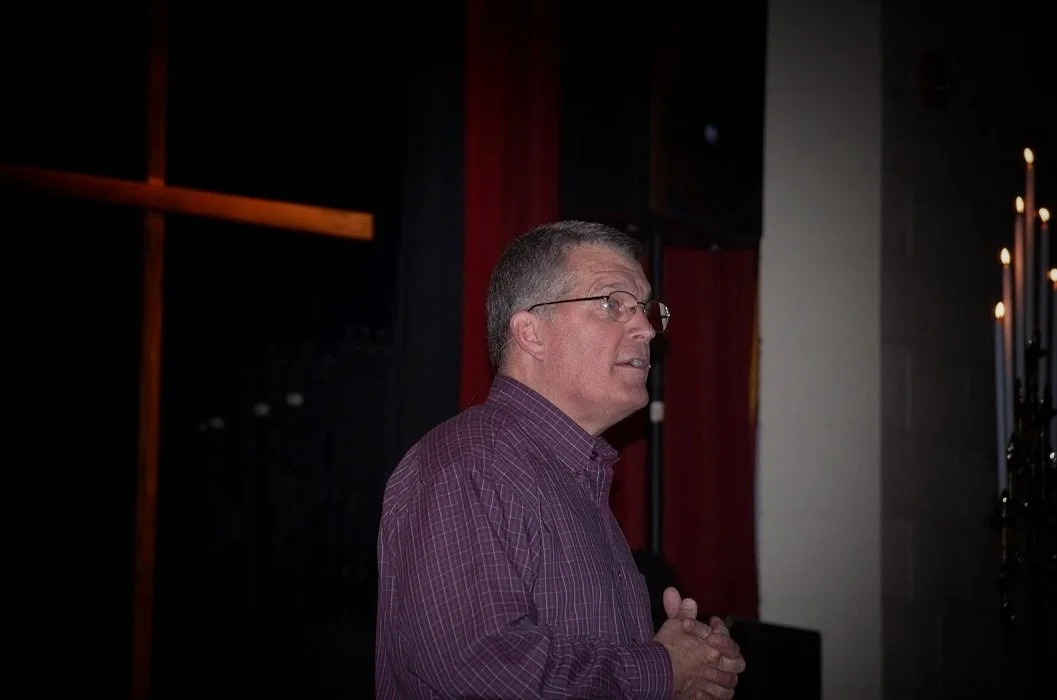
Hebrews 6:9-12 - May 3, 2026 - Rick Sutherland
/This powerful exploration of Hebrews 6:9-12 challenges us to examine whether our faith is characterized by active pursuit or passive possession. We're reminded that God's sovereignty doesn't negate our responsibility to obey what has been revealed to us. The message cuts to the heart of authentic Christianity by distinguishing between those who merely hang around churches and those whose lives bear the unmistakable fruit of salvation: faith, hope, and love. We learn that God, in His perfect justice, doesn't overlook our obedience and service to the saints. This isn't about earning salvation, which comes only by grace, but about demonstrating the transforming power of Christ in our lives. The warning against becoming sluggish or dull of hearing is particularly convicting. Like the Hebrews who had stopped applying truth, we risk drifting when we fail to respond to God's Word with immediate obedience. The antidote is earnestness, a wholehearted engagement with God's promises that keeps us actively connected to His Spirit rather than passively waiting for feelings to confirm our salvation. We're called to imitate the faith of those who believed God's promises even when the path looked impossibly steep, trusting that obedience strengthens hope and protects us from the gradual hardening that leads to apostasy.
Sermon Transcript
Good morning, church. That was pretty hearty. Last weekend, I was working in northern Virginia, and I was going to get done and get to head home later in the afternoon. Had a six-hour drive, and I was excited. I couldn't wait to get in my car and to pull up our service and to hear David teach this passage. For two reasons. One, he taught well that it was an exhortation. It was a strong warning that we needed to receive. We needed to hear those words. And I wanted to sit under that. And then secondly, I wanted to make sure that when he handed the baton off to me to continue the passage, because I'd already written a large portion of my manuscript that they meshed well. And so I had six hours, sat and listened, and I paused it a number of times because I was alone in my car. I could just hear the statements, the challenges, the exhortations, and as they would weigh and as I would try to let God poke them into my heart, they would elicit some responses and noises, right? Some of those were heavy to hear. And there might be a oof. Some of them were really good, and I was glad to hear them.
And then this weekend, yesterday, I was alone in the house for a large portion of the day, and I had a chore list. And I had my manuscript sitting on the table. And as I would walk through to get coffee or refill my glass of tea, I would stop to just read some of these passages to make sure I was good with how the words came out, how the particular thoughts were being expressed verbally today. And the same thing, I would read some of these statements and challenges and exhortations from Scripture, and they would really weigh on me, and they would really hit hard as God would say, you're speaking those words, but are you living those words? And so I will try to keep the theatrics to a minimum this morning, but if a woof or a mm escapes me, it's directed at me and not you, you can apply it to yourselves.
Our passage this morning in chapter 6, as we continue, are verses 9 through 12. I'll read these. These are the words of the living God. "Though we speak in this way, yet in your case, beloved, we feel sure of better things, things that belong to salvation. For God is not unjust so as to overlook your work and the love that you have shown for his name in serving the saints as you still do. And we desire each one of you to show the same earnestness to have the full assurance of hope until the end so that you may not be sluggish but imitators of those who through faith and patience inherit the promises." (Hebrews 6:9-12)
Let's pray. God, those are your words. And I pray that by your spirit, those words, the words to follow will pierce our hearts this morning. That as we sit under your words and receive the teaching that you have for us this morning, that it will fall on good and ready soil. And that through this exhortation you gave us through this preacher, we might be changed and be like Jesus. We might be equipped to love better, to serve the church and the world around us, and that through this exhortation, God, we will all be changed. Thank you for the time we have to study and to be together this morning. It's a blessing, and we receive it from you. In the name of the Christ, amen.
It is human nature for all of us that we want to have information before we make a decision or before we determine a course of action. And the more important the decision is in our life, the more information we want to have before we act. And that isn't wrong. Like I said, that's human nature, and there's wisdom in that. But there's also a trap in that that we have to avoid. And the danger is not in seeking wisdom, but in demanding exhaustive knowledge as a condition of obedience to God. The trap of self-idolatry appears when we refuse to act unless God reveals what He has chosen to keep hidden. The most important decisions of our lives are not made by uncovering God's decree, but by trusting and obeying the sufficient revelation that he has given. And though we don't see all things clearly, we don't walk in darkness. As we just read, God has spoken. And because God is sovereign, wise, and good, we are called to obey him with confidence, even when our knowledge is partial. "The secret things belong to the Lord our God, but the things that are revealed belong to us and to our children forever, that we may do all the words of this law." (Deuteronomy 29:29) And what is that, this law? It's revelation. It's what God has given to us, and it's sufficient for what he has called us to do.
Let me take a minute and give us a quick refresher on God's sovereignty. We throw that term around a lot. Let me tell you what I mean when I say it, when I use those words. You've heard me talk before about God's divine decree, right? God's divine decree is his eternal and unchangeable plan that brings about everything that God has determined to occur. We know that God does not react to human events and he is not surprised by them. His plan is not evolving and changing as he reacts to us. Before God created, he determined all that would occur and we, in our lives, experience his plan unfolding. It unfolds in the moments of our lives and we see how it has unfolded in history. All that we see happening now in our lives connects to what has already occurred in history, and all of it is the fulfillment of what God ordained before any human took their first breath. That's God's divine decree.
We can find this truth expressed in Ephesians 1 when Paul is speaking of us, the church, and he says, you "having been predestined according to the purpose of him who works all things according to the counsel of his will." (Ephesians 1:11) In his Old Testament, Isaiah speaks of this when God says, "I am God and there is no other. I am God and there is none like me. I declare the end from the beginning and from ancient times things not yet done, saying, my counsel shall stand and I will accomplish all my purpose." (Isaiah 46:9-10) But what is beyond our understanding and beyond what God has chosen to reveal is how does this divine decree interact with our choices? We know for sure that God is not the author of sin and he tells us in his word that we can't say that we are tempted of him when we're tempted. So in ways that we don't understand, God works to accomplish his will despite the rebellious and idolatrous decisions of his creations.
Humans have creaturely will to choose according to their nature, a choice to obey or to rebel against what has been revealed. And without grace, all of our natures are bound to sin. And only God himself knows how our choices interact with his decree. We know from Acts that the most evil act in history was the murder of the only sinless person to ever walk on earth. And Luke tells us in Acts that Jesus was sent to the cross according to God's plans, while at the same time the people that murdered him were held responsible for their choices. So if you say, how does that work? I'll tell you. I can't tell you how that works. I am declaring that it is truth, and at the same time telling you that we must obey what has been revealed.
We know this is true, and you've heard this often expressed during our study through the book of Romans, but it's important to have that perspective, that hermeneutic as a guide as we work our way through some of these texts in Hebrews. It's also important to remember that obedience, perseverance, and steadfastness are things that have been revealed to us in Revelation, but they are not causative and determinative in God's free choice of election. They are not the cause of election. They are evidence of it. In this life we can know what we see in our choices. We know what we can see in the choices and the fruit of others. But God knows who he has given to his son, and God ordains that those people will persevere to the end. So remember that as we continue to chew on what David taught us last week, and what we move into in our text for this week. 2 Timothy 2, we are called to rightly handle the word of truth. We obey what's been revealed, and we trust, as Carrie was telling, we lean, we trust, we leave to God the choices and the decisions that are beyond our understanding.
As we look at our text for this week, starting out in verse 9, we see immediately that the preacher is referring back to, connecting to what has just been said in verses 1 through 8. And he does it in a way, this is tough, this is exhortation, this is warning. And so the preacher pauses for a minute and he says, hey, remember, you are loved. You're beloved. This is the only time in all of Hebrews where that word, that reminder is used. People are called brethren. It is very encouraging, but this is the only time that the preacher stops and takes a breath and reminds them that they are loved. And that was important then, and it's important for us now when we sit under exhortation, when we sit under tough words.
Piper says it this way. He speaks very plainly. He was preaching and he said, it comes down to this. We are a nation of victims and whiners and pouters. If somebody says something negative about us, no matter how constructive they may try to make it, we either slump into a fit of self-justifying woundedness or we file a harassment suit. But he says this. He follows it up with this. Followers of Jesus Christ should be different. We don't need to be thin-skinned and vulnerable because we are chosen by God, loved by God, forgiven by God, accepted by God, indwelt by God, guided by God, protected by God, strengthened by God, and God should be more important to us than anyone else in the universe. So when we sit under exhortation, remember, we're guided by God, protected. His way is always best. We're strengthened in the exhortation, and these words are a kindness from him. But they are hard to live.
I grew up as a preacher's kid. My family was Baptists, and I don't know if you know this, but Baptists believe that every summer you should have special meetings. When I was 20 years old, I was questioning this part of their theology because their special meetings really cut into my summer free time. And that particular summer, a group of my friends and I were playing basketball every night when we got off work. And we had this running tournament and scored. We were really enjoying playing basketball. And having meetings starting at 7 o'clock really cut into that tournament time. So one evening we decided we would play for an hour, rush home, grab showers, and make it to church just as the service started. So that happened. I slid into church just as it was starting, went to my seat on my family row, took my Bible, slid under my chair, slumped in my chair and looked over at my parents to make sure they knew that I was being put out by their special meetings. And apparently my sullen attitude was not missed by the speaker.
So when he got up to preach that night, he stated what his text would be and he asked us all to follow along while he read aloud. And I didn't move, I just sat there. And he looked right at me and he said, son, if you're gonna follow along, you're gonna have to take that Bible out from under your chair. And after church, when we got home, I made the mistake of trying to find sympathy with my mom. And I went up and I said, can you believe that guy called me out like that? And my mom looked at me and said, what part of his statement did you disagree with? And I turned and walked away, right? Because that needs to be our response when we sit under warnings and exhortations that we find in the Bible. We know that God can't be wrong, so there's not going to be anything in the exhortation for us to disagree with. And we need to really examine our hearts if biblical exhortations cause us to react with sensitivity.
Our text this morning starts with the preacher saying, I'm speaking to you in a certain way, which begs the question, okay, what way are you speaking? There's two ways that the speaker is preaching. The first is that preachers, elders, shepherds get up and teach. They speak based on what has been revealed, truth we know from God, and what can be observed. We're not preaching from a position or a place of omniscience. So when David taught us that this is one of the warning passages of Hebrews, and we continue that this morning, we know that this warning is based on what has been revealed about God's commands and expectations. And secondly, when the preacher is saying we speak in this way, he is referring to the fact that this exhortation is strong, bold, and some may even find it harsh. But it all is encouraging us to move forward in Christ and to not slip back and return to self-idolatry.
In this first phrase of our text, we see David spoke about a shift last week. He closed by speaking about a shift. The preacher 1 through 8 is exporting very strongly. And then he turns toward his audience. He really narrows his aim. And he reminds them, like I said, hey, you are loved. You are beloved. I have confidence. And he assures them that he has confidence in what is ahead for them. Now this preacher would know, as every preacher knows, from their experience and observations, that there are people who hang around churches who fall away because they are without root. But in this passage, the preacher has confidence in this soil, confidence that God's seed has fallen on good ground. And he expresses this by saying he's confident that his audience possesses the things that belong to salvation. And you'll hear me say this several times today as I work through this. He is not confident because of omniscience. It's confident because of observable fruit.
And so what do we know? What is being spoken of, this observable fruit, that are called the things that belong to salvation? Well, over in 1 Corinthians 13, Paul is speaking. He's talking about people who show impressive outward expressions and spiritual gifts, but, and there's a big but, their acts are empty if they don't possess the core traits of the redeemed. And he sums up the section in verse 13 by saying, so now, faith, hope, and love. Faith, hope, and love abide. These three, the greatest of these is love. These are fruits of salvation. And while that's not an exhaustive list, it is a good place, a great place for us to start. Because there is a distinct biblical pattern throughout the New Testament where faith, love, and hope function as the true markers of a changed heart.
First, without faith, you don't even leave the starting blocks, right? If you don't have faith that Jesus the Christ is the Son of God, the way to God, you cannot be considered to be among his church. And with a true professing faith, there will always be hope in Christ based on the words of Christ. And this will produce love for the church and love for the world. The love that is produced by this hope and this faith is a byproduct of us being changed from what? From our selfish selves, from self-idolatry, into the image of Christ. The byproduct of that is producing love. What does Jesus plainly tell us about ourselves? How will the world know that we're his disciples? When they see our love one for another. That makes it pretty plain.
This love, there's different loves in the Bible. This is not sentimental love for pleasant and kind people who hang around in churches, right? Some of us are grouchy. Some of us are grumps. Most people who hang around in churches are pleasant and kind. But this is not a sentimental love from hanging around people who are like-minded. This week I was listening to a podcast from a guy who is just an avowed agnostic. But he was speaking about how he enjoys going to a church and being part of the community of church and being around people who share a common belief system and he finishes it with, even though I don't share their beliefs. Right? That's the type of soil that feels the rain, but where the seed isn't gonna take hold. Because without faith, you don't leave the starting blocks. So this is not the communal love from being around people you enjoy being around. This is a selfless love that gives up serving self in order to serve the church and to serve the lost who need to find Christ.
So can you, can I, articulate this morning, if you took out a piece of paper and made a list, can you articulate how Christ's love is showing in your daily choices? Do our actions, the choices we make every day, point to Jesus? As we see, these aren't actions that perfect our salvation. That's not what this is about. These are actions that prove the power of our Savior. And there is a distinction.
The next thing that we hear from this preacher as he continues is a statement about God's justice. Now tell me if you're like me. When I hear a statement about God's justice, I have the imagery of someone holding a sword, right, and doing things to people who are bad, people who deserve wrath. My mind just runs to avenging acts and the judgment of sin when I hear the word justice. But the exact words that are used are that God is not unjust, meaning he's just, and in his justice in this passage, he does not overlook our obedience, our works that he has equipped us for. Piper says divine forgetfulness is incompatible with divine justice.
So, like David did last week, let me tell you first what this does not mean. This statement, you cannot reach into this passage, grab this statement, pull it out, and undo all the theology of the New Testament that says salvation is not by works, it is by grace. Very clearly, consistently, throughout the Bible, salvation is by grace. So when God is justly remembering our works, there has to be a different meaning than it being salvific. And there is. He is just in remembering our obedience service and recognizing the rewards that he will give us for this obedience.
The original audience of this message, this sermon, was to Hebrews, a Jewish audience. So we can reach back into their history, something that they would have known, and pull out a great example for us. We know that Israel was God's chosen people. And one of the things they had been chosen for was to receive and to possess the land of Canaan. But their enjoying this reward, their possessing of this land, was proportionally contingent upon their obedience. The Lord was their strength. It had been revealed to them that they were to go in and possess this land. They had been told that. Deuteronomy 4 and 6 both say plainly, "go in and take possession of the good land that the Lord swore to give to your fathers." (Deuteronomy 1:8 / Deuteronomy 6:18) We read examples, though, of tribes that did not. Their enjoyment of the land was in their obedience to what they had been called to do.
This statement of God's justice cuts both ways. God is aware of our obedience and the love that we show to others on his behalf. But this is one of the statements that really got me. This is not a group project, right? This is not my parents, my siblings, my family, my church. None of us gets to get lost in the crowd when God is just in remembering our obedience. God knows us individually, our hearts, our choices, our actions, and God graciously rewards the obedience that His Spirit produces in His people. And the preacher in the text calls out a specific type of obedience and love. The text says, "Love for the name of Christ in serving the saints." It's not the affectionate love you feel for your spouse or children. This passage is calling out and making known a tangible demonstration for the love of God and for his name by how we serve his son's bride, the church.
The preacher in this text calls out the love, but if we jump forward a couple chapters, chapter 10, he specifically describes it. "For you had compassion on those in prison, and you joyfully accepted the plundering of your property since you knew that you yourselves had a better possession and an abiding one." (Hebrews 10:34) That was their particular love for the saints that was being called out. We also hear from Christ what this looks like in John 13:34. "A new commandment I give to you, that you love one another just as I have loved you, you are also to love one another. By this all people will know that you are my disciples, if you have love one for another." (John 13:34-35)
One of the things I had never caught before I was preparing this week was the way that Jesus was raising the standard with these words. And I looked at that. I'm like, verse 34, a new commandment. Why is this a new commandment? Jesus himself repeats from the Old Testament where we are taught and called to love our neighbor. But what was the standard that was given in the Old Testament? Somebody finish it. Love your neighbor as you love yourself, right? What does Jesus say is the new commandment? Love as Christ has loved us. That's a big distinction. Our loving service to the saints becomes the visible expression of our invisible devotion. While we are promised a reward, the transformed heart is not driven by the reward. We are motivated by our love for the one who redeemed us.
Verse 11, we are told about a hope in earnestness. Let me begin to answer what is that hope and earnestness by asking this question. Does your hope in Christ look like active pursuit or passive possession? Let that sit there for a minute because this is one of the ones that got me a couple times this week. An active pursuit of my hope in Christ or a passive possession.
Listen to what Peter says in 2 Peter 1. "For this very reason, make every effort to supplement your faith with virtue and virtue with knowledge and knowledge with self-control and self-control with steadfastness and steadfastness with godliness and godliness with brotherly affection and brotherly affection with love. For if these qualities are yours and are increasing, they keep you from being ineffective or unfruitful in the knowledge of our Lord Jesus Christ. For whoever lacks these qualities is so nearsighted that he is blind, having forgotten that he's been cleansed from his former sins. Therefore, brothers, be all the more diligent to confirm your calling and election, for if you practice these qualities, you will never fall." (2 Peter 1:5-10)
Think of it this way with this analogy. Let's say that you are a father with two children. You have 100 acres, you have two children, you give each of your children 50 acres. You do the paperwork, the deed is completed, there's no mortgage, they own the land. One of your children goes to Lowe's, buys a couple fruit trees, drops them off at the property, doesn't visit it again. Goes back to working their current job, living in their current house, and the land and the fruit trees sit there. They produce a little. Nothing else happens. The other son moves to the land, builds a house, clears the land, plants fruit trees, gardens, lives in the cabin, lives on the land. Neither of them is trying to earn it. They already own it. But which one looks like an act of pursuit and possession of what was given to them by the Father.
Our obedience to Christ in living and serving his church is life-giving and rewarding for us, and it shows the church and it shows the world that our God is worthy to be obeyed and served and that he changes lives by his redeeming blood. Let me read that one more time. Our obedience to Christ in living and serving his church is life-giving and rewarding for us and it shows the church and the world that our God is worthy to be obeyed and served and that he changes lives by his redeeming blood. This is how Paul says it in Ephesians. He says, you were dead in sin, God made you alive in Christ. By grace you are saved. And then he continues in verse 10. "For we are his workmanship, created in Christ Jesus for good works, which God prepared beforehand, that we should walk in them." (Ephesians 2:10) Grace for salvation, redeemed and called out for works saved, that we should walk in what God has called us to. Earnestness keeps us actively connected to God's promises. It keeps us connected to his equipping through his spirit rather than sitting back and passively waiting for feelings to convince us that we are saved. Obedience strengthens and deepens the hope that we have in Christ, and this hope protects us from the next warning that we receive in our text.
That warning is, don't become sluggish. If you remember back a couple of weeks, I think it was Don that taught us from chapter 5 and verse 11. And in that text we read, about this we have much to say, and it is hard to explain since you have become dull of hearing. The preacher was saying, I have much to exhort you about. I have a lot to say. But it's hard to share truth with you because you're dull of hearing. That Greek word, dull of hearing, is the same word today in verse 12, sluggish. Same word. So these Hebrews had begun to become dull of hearing regarding what they were being exhorted about. They had stopped applying the truth that they were being taught, and the result was they became sluggish.
It's important for us to have a clear understanding of what's being warned against. This isn't the sluggishness of, it's cold in my house, and I don't want to get out of this warm bed. It's a chilly morning, right? We all feel that type of sluggishness. Do you remember David asking last week what the difference was between falling into sin versus falling away? Well, that heart-heartedness rarely just occurs all at once. And this hardness of our heart is formed when we actively stop responding to God's truth, which allows the drift to occur that we're warned against in chapter 2, when Jay taught about that. What are we drifting from? We're drifting from instant obedience and we are turning our eyes away from what has been revealed. And when that drift continues, the deceitfulness of sin will reshape your affections and your thinking. That deceitfulness of sin will promote us into self-serving, promote us above God, and it makes our dullness and sluggishness toward God feel normal. And that is the trajectory toward apostasy. Matter of fact, this in chapter 6, chapter 5, is a repeat of what was warned against in chapter 3, very explicitly. "Take care, brothers, lest there be in any of you an evil, unbelieving heart, leading you to fall away from the living God. But exhort one another every day, as long as it is called “today,” that none of you may be hardened by the deceitfulness of sin." (Hebrews 3:12-13)
And that warning brings us to our last call today, a positive one, which is to imitate and inherit. Inheritance, right? Inherit. We know what that word means. Inheritance, we probably all have a secret dream somewhere in the back of our mind of the uncle we haven't thought of for years and years and years. I looked for, to try to find the biggest inheritance I could find. 2019, David Koch died and left his wife $50 billion. $50 billion. $50 billion. That's the right boundary. The left boundary. 2025, my dad passed away. And my mom told me and my brothers we could go into his closet and pick out any dress shirts and ties we wanted, okay? Left boundary, right boundary. But we all understand what inheritance means.
So when we're exhorted in our text to imitate and inherit, what and who? Who do we imitate? What are we inheriting? Romans 4, Paul says it this way, verse 13. "For the promise to Abraham and his offspring that he would be heir of the world did not come through the law but through the righteousness of faith. For if it is the adherents of the law who are to be the heirs, faith is null and the promise is void. For the law brings wrath, but where there is no law, there is no transgression." (Romans 4:13-15) Verse 16, that is why inheritance, it depends on faith in order that the promise may rest on grace and be guaranteed to all his offspring. No unbelief made him waver concerning the promise of God, but he grew strong in his faith as he gave glory to God, fully convinced that God was able to do what he had promised.
Abraham did not inherit the promises of God because who his father was or because of how well he followed the law. He inherited it because he believed that God was truthful and faithful. And we've looked ahead before in Hebrews, but over the horizon a little bit in chapter 11, there's a whole list of people laid out in what we call the Faith Hall of Fame. These are who we are to be imitating. For us to be imitators of these people that God calls out, we must adopt their posture in light of what they went through, and imitate what they believed about God.
There are two facets to this imitation. One, we exercise faith by obeying what God has revealed to us and called us to. And in our obedience, God works in us by His Spirit to produce the fruits of His Spirit. And the second facet of this imitation is that we persist even when the path seems to be straight uphill. We don't let the challenges that we perceive impede our obedience. Rather, we look at them as ways God will demonstrate his power and his glory in keeping his promises. We know this because Abraham and Sarah didn't have Isaac when they were in their 20s, right? They heard the promises, they saw the path, it looked straight uphill, and God delivered on what he said he would do.
David told us this passage was one of the strongest, boldest exhortations in the New Testament. Here in Hebrews we find it. But its boldness is directly proportional to the attention that we give to it. I know from experience that we can sit in those chairs and shrug off anything we hear. So an exhortation is only as bold as the attention that you give to it. And there's real applicational value this morning in camping out for a minute on these exhortations and asking ourselves how will we apply them. And to be pastorally gentle this morning, I'm going to do what I've been doing all week and preach this to myself and let you guys listen in and let God push it into your heart.
Every week, Sunday after Sunday, I'm blessed to come to a local church that promotes and values the clear teaching of Scripture. We sit under God's very words. But if I sit here week after week under the teaching of Scripture, and I don't leave with a clear call to either confront my sinfulness or equip my obedience or both, how would I say that I haven't become dull and sluggish? How am I going to apply these truths in my week ahead if I'm not sitting there taking notes either mentally or on paper? If I don't take the time to review the passage and the notes and then in my quiet time ask God, what is it you're calling me to change? Or how are you calling me to be equipped for my week ahead? I can confess most Sundays, talk to people, shake hands, go out the door thinking about what lunch is. And sometime during the week, I might have a memory of what was spoken. But I don't walk out of here with a game plan of that's the truth that I just heard. And I'm going to apply it because I know the sinfulness it's butting up against. So I ask again, how am I not sluggish and dull of hearing if those are my actions? And all week I ask those tough questions of myself. I'm asking them again. And I'll ask that God directs each of those questions into each of your hearts for whatever work he has for you. And all of us can ask the Lord to equip us and prompt us to press forward in occupying his promises and fighting off the sluggishness and the dullness of hearing that allows our heart to drift from these truths.
Let's pray. Lord, we believe your way is best. We believe life, protection, and joy is on your path of obedience for us. God, and as the song says, we are prone to wander. We are so prone to want to be in charge of our lives and sharing the throne or knocking you off the throne, God, so that we can self-promote and seek after our own affections and choices. And God, I ask for my heart that these words and this exhortation about not becoming dull of hearing and sluggish, not drifting, not letting hardness form on any part of my heart, be true, be piercing, be persistent, and that I will hear and answer this call to imitate those who by faith believed you and obeyed you, demonstrating the transforming power of the Son of God. I pray this over my brothers and sisters and ask that you would reveal to each of us what needs to be changed, how we need to be equipped for your glory. And thank you again for our chance to be together this morning as we continue, God, in remembering the sacrifice of Jesus in his death. Through your resurrection of him, God, may we continue to worship at the communion table this morning, celebrating the hope that we have because of what you've done. In Jesus' name, amen.