
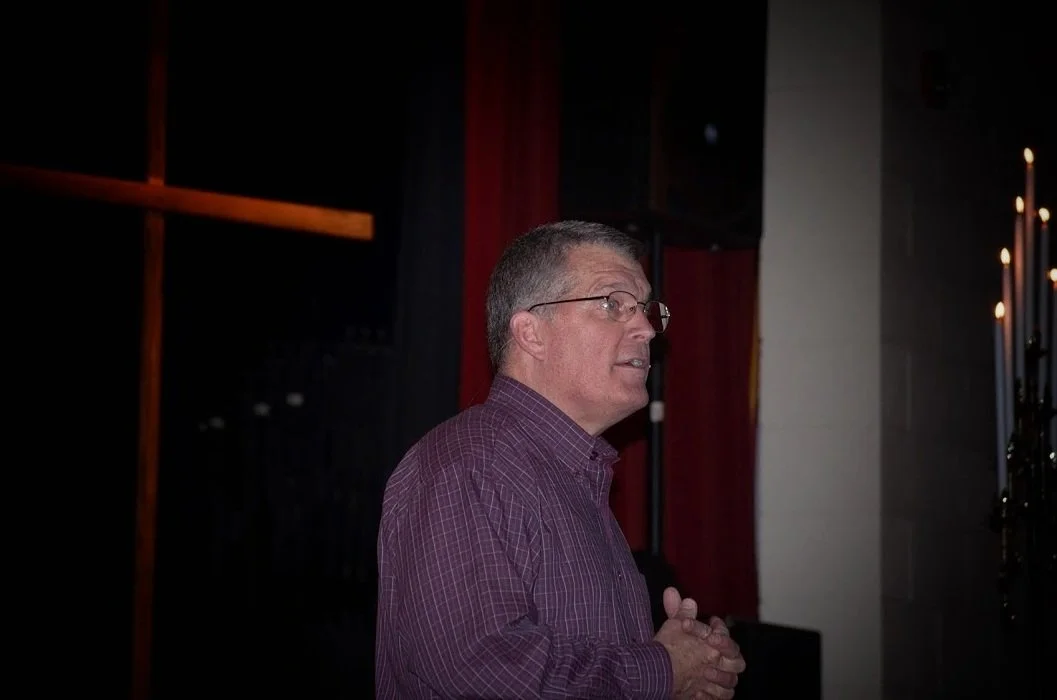
Look to Jesus - Hebrews 12:1-4 - November 15, 2026 - Rick Sutherland
/Rick Sutherland opens his sermon on Hebrews 12:1-4 by anchoring the passage in what came before it. The word therefore at the very start of chapter 12 immediately turns our attention back to the great cloud of witnesses from Hebrews 11 — those Old Testament saints whose stories of faith were unpacked over six weeks of teaching. Their lives serve not merely as historical accounts, but as living testimony to God's sustaining grace. They surround us like spectators in a stadium, both inspiring and holding us accountable as we run our own race.
From there, Rick draws a sharp and practical distinction between weights and sin. A weight is anything — even something good on its surface — that slows our conforming to the image of Christ. Sin, and particularly the besetting sin that "clings so closely" (Heb. 12:1), is the constrictor wrapped around us that we have learned to accommodate. Borrowing from John Piper, Rick challenges the congregation to stop asking merely is this a sin? and start asking is this helping me run? The call is not just to name and confess these hindrances, but by the power of the Holy Spirit, to mortify them — to take the battle to them and put them to death.
The sermon reaches its heart in the command to look to Jesus, the founder and perfecter of faith. Jesus is not simply the greatest example of someone who ran the race well — he is the very reason we can run at all. He obeyed where we fail, bore judgment where we deserved it, and sustains our faith from regeneration through sanctification to final glorification. He endured the cross by looking past his suffering to the joy set before him — the great multitude of the redeemed worshiping before the throne described in Revelation 7:9-12. And so Rick closes with Paul's words from 2 Timothy 4:7-8, calling the church to love and long for Christ's appearing, because it is that eternal perspective — not the crowded calendar of this temporal life — that enables us to run with endurance to the finish line.
Transcript
Good morning.
A couple of weeks ago, Jay sent me a text and he was looking at how we had chapter 12 divided up. And originally the first part of the chapter was two messages, and he was trying to decide if a verse would fit better in the the first section or the second. So he sent me a couple of options and I looked at it and I said, we can do either one, but if you give me that section you have laid out, it's going to be hard for me to stay under 7,500 words. Now he does his best to keep me under 4,000. So he said, let me talk to David. We might make this into three sermons.
So, so he ended up rechunking it, and I ended up with one through four. And what a delight that was. And so I got the text a couple of weeks ago and started looking at it and realized that the outline is right in the text. God already put the outline right in the text, and I could tell it was just going to be a delight to study it and teach it. And so I'm excited for us to look at it this morning. Our text is Hebrews 12:1 through 4, and I'll read that. And as always, these are God's words.
"Therefore, since we are surrounded by so great a cloud of witnesses, let us also lay aside every weight and sin which clings so closely, and let us run with endurance the race that is set before us, looking to Jesus, the founder and perfecter of our faith, who for the joy that was set before him, endured the cross, despising the shame, and is seated at the right hand of the throne of God. Consider him who endured from sinners such hostility against himself, so that you may not grow weary or fainthearted in and your struggle against sin you have not yet resisted to the point of shedding your own blood." - Hebrews 12:1-4
God, those are your words for us this morning. You knew when you gave them that we would gather this Sunday to study them and to seek by your spirit to have the light of these words shined into our lives, to show us what needs change to be more like Jesus. And so here we are now, before your words and by your spirit we agree and ask that you will bring that to be that this morning we'll set aside the other things running through our minds, the concerns that we'll have when we get up and head out, the things that are in front of us this week. And for these moments, God, turn our hearts to what you're calling us, to what you have given us in these verses, and we look into this well of truth now, Jesus, and ask that we will find new meaning and new application. It's in your name we pray. Amen.
As I was studying, I found somewhere on the Internet, and I don't remember the source, but I found a list of notable human achievements. And so I read through the list and I thought two of them really stood out to me, really extraordinary human achievements. The first is in 2008 at the Olympics. Most of you, well, not most of you, some of you will remember this. Michael Phelps was in eight events at that Olympics, and he ended up sweeping all eight of those events and winning gold medals. And after the first seven, when he was preparing the days ahead for his eighth race, I remember stories about you could not get tickets, you couldn't find tickets. The secondary Market was insane because everyone wanted to be there to see this potential extraordinary human achievement. And as he made the last turn and was swimming the last leg of that eighth race, the crowd was just out of control, cheering and screaming all the way to the wall as he won his eighth gold medal.
And then in 2019, for the first time ever documented in human existence, somebody ran a marathon in under two hours. Sub two hours is, I don't know if you've ever seen this, but on YouTube, there's this giant treadmill and they haul it around to different arenas and sports gatherings. It's a giant treadmill that is set for the pace of a sub two hour marathon. And you sign a release and you get on this thing and see how long that you can run at the pace. And most people are taking these giant, enormous strides, trying to keep up with this belt. And they last like 10 seconds and it spits them off the back. And then you realize that somebody did that for two hours.
In both of those scenarios, the Olympics and the sub two hour marathon, there were these giant crowds there cheering and screaming as the competitors closed in on the eighth gold medal in the record. And I tell you that to ask you this morning, what is your greatest competitive achievement? When I asked that, most of our minds probably drift to the arena of sports, but we can broaden that a little bit to academia, fine arts, the local pie baking contest, whatever category you need to be able to include your greatest competitive achievement.
Now, I asked myself that question as I was preparing. And I played sports my whole high school career at a small Christian school. Then I went to Bob Jones University and I played intramural sports for four years. But I was racking my brain and I couldn't think of a single standout moment that would Define my greatest competitive achievement. But then I remembered something amazing. I remembered a trophy that I have that nobody else in this room is going to have. That's right, everybody. First place grease pig.
When I was a kid, our church hosted a rodeo day at a piece of property that we owned. And this was the 80s, so things were different. But the adults thought it would be a great idea to surround a corral with adults, fill the corral with little kids and one greased terrified piglet, and then yell and encourage us as we ran around trying to catch this terrified animal. The adults, as our text would say, were this cloud of witnesses ringing the corral, both cheering us on, but also making sure the pig didn't escape. And after about 15 minutes of really unathletic children chasing a terrified animal around a corral, one of the bigger and slower kids tripped and fell onto the pig and stunned it. And being the opportunist that I am, I ran in, grabbed that pig, held it above my head, and claimed my trophy.
Now, put a pin in that. I'm going to get back to that in a minute. But turning to our text, as we start into chapter 12, the very first thing we're to do, we're headed into chapter 12. We get one word in, and we're told to turn around and look backwards. We're directed by this word, therefore. And this morning, don't get frustrated with me thinking, hey, we just collectively finished chapter 11, and now we're going right back to it, because this is the first thing our text calls us to do. So a quick refresher of where we've been, starting on September all the way through November, and we spent six weeks and listened to 35,000 words expounding on the text of chapter 11.
And as we move out of it to chapter 12, the first thing we're told to do is, is to look back to what we've just covered. And we don't have to dwell on this very long, but we're told to look back for a very specific purpose, because chapter 11 was preached as the footing for what we're now going to be called to in chapter 12. And the reason that we're looking back, and the reason I brought up that silly story about my pig trophy is because chapter 12 immediately draws our mind to an athletic metaphor, to an imagery of a stadium filled with spectators. And those of us who are competing, us, each of us running our race, are surrounded by witnesses observing us from the stands.
The cloud of witnesses spoken of in our text are these Old Testament Figures who we just spent the last six weeks studying from Chapter 11. Once more, a quick reminder, these are our cloud of witnesses. And as you think back over those six lessons from chapter 11 and what God taught us in the stories of these Old Testament saints, these Biblical, Biblical figures become exemplars, we're told that they're witnesses, observers of future generations, spiritual races. And we are to remember, be aware of this cloud of witnesses surrounding us and the fact that their lives, one of the things that they are witnesses of is their lives, testify of God's grace for the race that all of us are now engaged in. And they provide not just accountability, but inspiration in the story of God's grace in their lives. We read about their lives in Hebrews 11 and throughout the Old Testament. And their stories encourage us to persist in our own race.
Now, as we push to the finish line in our text this morning, we see we're called to in our race, in our training. We are to lay aside every weight and sin. And there's a distinction made between these two. Starting very broadly, a weight is anything that impedes our spiritual progress. This can include things that are good on their face but hold us back from Christ, or it can include things that are bad on their face and we shouldn't be engaged in. But a weight is anything broadly, anything that slows us down in our conforming to the image of Christ.
And then going from broad to narrow, we can start identifying and naming specific weights. The things holding us back can be a habit, an area of comfort, maybe theologically a way of wrong thinking or some way that the world has corrupted your mindset. A hindrance can also be a hindrance of sin. Could be your temper, your tongue, laziness, selfishness, drugs, immorality, lying, stealing pornography. We could, we could name a whole list of sins. But under that broad text of identifying any hindrance, we also have to look for maybe relationships or environments that could be slowing us down from the race that we're called to run.
Think about this. Our mindset should not be that somebody has to come to us and provide proof that something in our life is a sin or a weight. Because all of us can be honest and say, my life is full of hindrances. My life is chock full of things that are slowing me down. And rather, we should be praying that God reveal them and equip us to be willing to toss those things aside. Piper says this. He says,
"I heard someone explain that we must lay aside not only the entangling sins, but rather every encumbrance that's how some translations stated every encumbrance, that is every weight, are obstacles, things that in themselves might not be sins. And to his thinking, that was revolutionary. What it did and what he hopes it does for us was to show me that the fight of faith, the race, this Christian race we're in, is not fought well or run well by asking what's wrong with this or that, but rather by asking, is it in the way of greater faith, greater love, greater purity, greater courage, greater humility, greater patience and greater self control? Not is it a sin? But rather, does it help me run? And if not, is it in the way?"
We can all recognize this conundrum, right? If you've ever tried to lose weight and imagine that you tried, imagine that you hired a personal trainer or maybe you just have a really helpful spouse, right? And they could point out five eating habits, five lifestyle habits, say, here's these 10 things that you need to work on to lose weight. The issue isn't recognizing there's things in my life that I could get rid of to lose weight. The question is, what am I willing to do to achieve my goal, right? Same thing in this Christian race, what is it that we're willing to toss aside and recognize it as a hindrance?
We're also called not just to lay aside sin, but specifically specific type of sin is called out. It's the sin that clings so closely to us. Some versions say this is our besetting sin, a repeated sin that trips us up. And the Greek word that's used there in Hebrews literally means cleverly placing itself around to exert tight control, which captures the imagery of something that wraps around you and strangles you, right? Like a constrictor of some kind. I told my daughter I had an image to show a python squeezing an animal. But we don't really need that image to all be able to imagine that. And she thanked me for that. But you think about that, a constrictor that's there and squeezing and squeezing and squeezing, and then realize that we all have that sin in our life and we accommodate that squeeze.
When Brad preached a couple weeks ago, he asked us that famous question from R.C. sproul. And this was in the context of people hoping their good was going to outweigh their bad. And he asked the question, but what are you going to do about your shame? And when I talk about entangling or besetting sin, each of us knows the sin in our life that is wrapped around us. We all know the sins that cling closely and trip us up. It could be a specific lust that we battle, a group of friends we know aren't good for us, but we've become comfortable with them, or any other specific sin that we've been deceived into, thinking either that we really do enjoy it, or the worst thing is it's not that bad, right? Have you ever told yourself that it's not that bad?
The critical application of this part of our text is that it calls for a deliberate change. We first have to recognize and identify the sins that have wrapped themselves into our lives. But recognizing isn't where we stop. We have to take decisive action by God's power to set them aside and to remove them. Sanctification is a lifelong work of God that conforms us into the image of Christ. But that lifelong process requires deliberate action, decisive action on our part. It's not enough that we can acknowledge our sins and name them, confess them and ask forgiveness. Yes, we should. But when do we turn then? And by the power of the Holy Spirit, repent of them and mortify them. Take the battle to making them disappear. And that's what it means to put sin to death. And that's what we are called to do.
The preacher continues in our text to use this metaphor of this race to call us into action. And we're told why it is that we need to lay aside, throw off weights, throw off hindrances, throw off things that tangled us. And because it's because a race has been set before us and we're told that this is a race of endurance. This is not a sprint. It's a race that requires sustained faithfulness. It's our Christian life, and it's a journey of obedience to what's been revealed in Scripture.
The race has been set before us and the course has been established. It's not a treasure hunt where we're trying to find our way or we're hoping to find a path. We have been told what to do. Follow Jesus, be like him in this life. That is the race. We're committed to the course, and we're trusting God to guide us and to equip us. And what he asks is that we have faith and run according to the Revelation that he's given us and he promises us. He makes it clear that trials and obstacles and hard times are going to be on this course. But faith and obedience and discipline are how we run and compete without giving up.
So acknowledging that we're in a long race, a race of endurance and the training the running, the running this race out is going to require cutting off things that we enjoy, cutting off things that are part of our life. Well, that sounds tough and intimidating, right? Hopping on that treadmill, going an insane speed, and being told two hours to break a world record. Most of us wouldn't even climb on that treadmill, right? Well, running our Christian race, knowing what's ahead of us can be very, very intimidating.
So what does the preacher do? He gives us the words, look to Jesus. Look to Jesus. You have this intimidating race. I don't know how I'm going to run it. Well, that's okay. Look to Jesus. And pointing our eyes to our source of inspiration is an acknowledgment that, yeah, this race is going to be hard and this race is full of distractions. Can all of you admit with me this morning that in a life that's supposed to be temporal and a stopping point along the way to eternity, that our lives are full of distractions? The pool of this world is really, really strong. And we become entangled in this life and take our eyes off the race that we're to be running.
When we're told to look to Jesus, our fixation on him is multidimensional 1. He is someone that's run this race and knows the struggles. That's always good to be able to look to someone who has experienced what we have. We can look to him because he's been over the course. And we can look to him because he is the trailblazer for this course. He didn't just run the race, but he ran it perfectly to completion. Right. Why would we follow after and athlete or a training program that ended in disaster? Right? That's not what we want to emulate. Jesus is the only one who can look you in the eye and say, emulate me. Follow what I tell you to do and you will succeed.
The tough part of that statement is we want to define what success looks like, right? And his version of success is, follow me and you will have persecution in this life. Follow me and suffer for the gospel and I will glorify myself in your race. And that's not what we want success to look like. Even though we fall short in this life, his example never will. And that's why, third, he's the ultimate example. We can fix our gaze on him because there's no other example we should even be considering. If we go back to the arena of sports, you talk about who was the greatest boxer, quarterback, basketball player, there's room for discussion. You'll Find people who are passionate about different sides of those arguments. But when you talk about this race and running this race to completion, there is no one else to look at.
Our text goes on and further describes Jesus as founder and perfecter. We've probably all attended a previous church or maybe a educational institution that celebrates Founders Day. And in those institutions, it's undeniable, right? There was someone who started that ministry, started that university, started that educational institution. That person is credited with beginning the ministry. But we don't take that next step, right? We don't say any of them are the perfecter, right? Because they're all human. We're all human. And God certainly works through us and empowers us as humans. But at the end of the day, we're all imperfect. And in all of us, whether you founded a ministry, whether you started something amazing, still we are all being changed to resemble the only one who could be called founder and perfecter.
What is it our text is telling us about Jesus as perfecter? Well, we've just studied this chapter in 11, right? All these saints, all these saints that were saved by what? Everyone who's ever been saved has been saved by faith. Old Testament saints were saved by faith. We have been saved by faith. But while they in the Old Testament had a sure faith, it was a sure faith with an incomplete Revelation. And they lived in a time where they could not enter into the very presence of God.
But Jesus as founder and perfecter is not merely the greatest example of someone who successfully ran the race we are on, but he's the reason we can run it all, right? He's the reason that we even can run. Where we fail in obedience, he obeyed perfectly. Where my sin demanded judgment, he bore that judgment in my place. Where my strength fails every day, he sustains me by his grace. And he's the founder and perfecter because he has not only secured my salvation through his finished work, but then on my race, he preserves and protects my faith because I am part of his elect.
Jesus founded our faith by entering into creation, living a sinless life, dying for our sins, and being raised from death to have victory over sin and death. The Greek word in this passage that's used for that term, perfecter, it literally means completer. Completer. The one who brings something to completion. And faith is a gift from God. And Jesus is the one who brings our faith to completion by sustaining it and equipping us to run the race we're told is before us. And when he perfects us, it's along the way it begins with regeneration continues where we are now in sanctification, and we look ahead to completing the race in glorification.
Next. Our text says that Jesus endured for the joy that was set before him, and this is descriptive of his experience in another way that we are called to follow his example and to be like him. Because Jesus endured the cross and what he knew was coming and having to atone for all of our sins. And he did it by looking across time, looking beyond what was right in front of him, looking to what we see described in Revelation, chapter 7, verse 9.
"Behold a great multitude that no one could number, from every nation, from all tribes and peoples and languages, were standing before the throne and before the Lamb, clothed in white robe, with palm branches in their hands and crying out with a loud voice, salvation belongs to our God who sits on the throne and to the Lamb. And all the angels were standing around the throne and around the elders and the four living creatures and. And they fell on their faces before the throne and worshiped God saying Amen. Blessing and glory and wisdom and thanksgiving and honor and power, and might be to our God forever and ever. Amen." - Revelation 7:9-12
The joy that Jesus endured for was to look past his suffering in this temporal life and to see across time his bride restored to the Father, justified by his blood, and worshiping at the Father's throne because of the obedience of the Son, because he ran his race with endurance. And what the Son preferred and chose above any other choice, distraction, weight or sin, was obeying the Father and glorifying the Father in his redemptive plan for the elect.
Going back to the track analogy, if you've ever been to a high school football game or maybe a track event, you know what a standard track looks like. It's 400 meters. And the longest race that's run on just the track alone without leaving the Stadium is the 10,000 meter race. It consists of 25 laps around the track. This race is part of the Olympic events. And in the Olympic events, when they run their 25 laps around that track, every time they come around, they pass the podium stand, the medal stand, and they look to that platform, those podiums where the winners are going to climb up and be acknowledged, stand in front of the crowd and receive their medals.
Every time around, they have a clearly identified goal and understand the crown that they're running for. They're competing for the glory of that podium, of hearing their anthem, waving their country's flag and receiving their medal. There's pain, there's cramps, there's tiredness, along the way, there's other runners, and yet they clearly know what they are running for, and they don't get caught up in the distractions of what they're feeling or experiencing. That's how we are to run.
We read in our text, for the joy that was set before him. He endured the cross, despising the shame, and he seated at the right hand of the throne of God. Consider him who endured from sinners such hostility against himself. In our text, we see that Jesus endured in two ways. One, on the cross, we all understand this. He endured the penalty for our sin. The cost of him atoning for our sin was shedding his blood, satisfying the wrath of God, giving up his life and dying so that he could gain victory over death and sin. That's what we mean. When he endured on the cross, our text also says he endured hostility from sinners. And in many versions and in the Greek lexicon, an alternate understanding of that word hostility is the word contradiction. That doesn't always work well in our English. But understanding that contradiction, my favorite commenter said it like this. John Gill said,
"For Jesus, this was contradiction against his person. They denied his deity, spoke against his sonship and against all his offices. They mocked him as king, they derided him as prophet, and treated him with the utmost contempt as a priest and savior. It was contradiction against his actions, his works of mercy to the bodies of men because they were done on the Sabbath day. It was contradiction to his conversing with sinners for the good of their souls, as if he was an encourager of them in their sin and a partner with them. It was contradiction against his miracles, as if they were done by the help of the devil against his whole series of his life, as if all of it was criminal."
The life, the race of our Creator, our Messiah, the Son of God, was spent being castigated as a liar, as a rebel and as a criminal. And he endured it all to show us, when we look to Jesus, that we don't have to grow weary in our race. I asked you earlier, could you point to your entangling sin? Could you point to the source of your shame? And we all can. On this hand and on this hand, if I could say and ask you, what are the struggles you're going through? What are the difficulties in your race, the hardships? All of us could name them. Things we've been through, things we're going through, things that are on the horizon, we all have them because it's part of our human condition, fallen nature and the race that we're on.
And can we all admit this morning that the weight of those hardships in them, we struggle with the temptation to question God's goodness, to question his purposes, to get frustrated with him because he doesn't deliver on our timelines. Those frustrations, those wrestling against God's sovereignty, they lead to weariness. They increase our tiredness in our Christian race, and they can cause us to become faint of heart. But we have an antidote, and his name is Jesus.
We just heard that he endured a whole life of struggle and hostility, so that when he says, look to me, we can see what he endured. We can see it and we can point others to it. It's not just a source of hope for us, it's a testimony that we can point others to. And we can take comfort knowing that he has shown us how to live for the glory ahead and not to grow faint because we are in a struggle.
Now, we get to the last part of our text this morning, and I thought it was interesting that the preacher doesn't ask this as a question. He doesn't say, are you engaged in a battle of sin? He just says, you are. And we are engaged in a battle of sin. It's a war every day. And we're asked, in your ongoing sin battle, has your resistance ever reached the point where you shed your own blood? When you look at this in context, when I study this, there's two different ways to interpret this. Interpret the question that's being asked here by the preacher. The first is because the preacher is pointing us back to chapter 11. Is he talking about the list of saints and what they endured? The other way is we've just been told to look to Jesus. So are we told to look to Jesus and how he shed his blood and what he endured?
I'm not going to take a hard stance on which one of those I think is the most correct, because they both have merit in understanding and applying this passage. The Old Testament saints shed their blood through external persecution and martyred them. That was brought onto them by external reform forces when they refused to recant. And Jesus shed his blood through internal resistance, resistance to the temptation to abandon death on the cross and deliver himself by a power that he possessed. And if you take that interpretation, to emulate the example of Jesus means we have to refuse to disobey God's revealed word and what he has called each of us to do, regardless of the personal cost.
When Jesus resisted to the point of shedding blood, it was the ultimate commitment. He wasn't just dying on the cross, which he did, but he was resisting a temptation, an escape that he possessed, and he resisted the temptation to escape the horror of having to pay for our sins. And I can speak for myself and say that my resistance to temptation and my fight against sin is an often pitiful exercise compared to what I see as an example in Christ. And each of you knows your own fight and what that looks like. The sin that we are willing to accommodate and say it's enough to confess it and not have the obedience to mortify it and to kill it off. One more quote from Piper. He says this.
"The main point of this text this morning is the one imperative that's given in the Greek language, and it is run. Everything else in this passage supports this imperative. Run everything else explains it, gives motivation for it. Run the race set before you. You're not strolling, you're not meandering, you're not wandering about aimlessly. Run it like it's a race with a finish line, and that everything is hanging and depending on you crossing that finish line."
As we've been teaching our way through Hebrews, we've had some ongoing conversation about who the preacher was, right, who gave us this message, and then maybe who wrote it down. I've told you before that I think it's Pauline. And in light of that, when I was studying this today, this last couple weeks, in light of the lens of believing this is a message that Paul preached, it really jumped out to me and I found great crossover when I looked in Second Timothy, how Paul spoke on this very topic. And look at that. And second Timothy four, seven,
"he had a race in front of him, and he fought the good fight, he finished the race, and he kept the faith. And because of that, or henceforth there is laid up for him a crown of righteousness which the Lord, the righteous judge, will award him on that day, and not only to him also, but everyone else who has loved his appearing." - 2 Timothy 4:7-8
Now, when you hear that verse, we can probably think of numerous times we've heard that text preached at a funeral. We're comforted with those words, right? That the loved one, the person that were there to celebrate, that they fought their fight, they finished their race, and they kept the faith. And that's certainly something all of us should be striving for in our lives. But the end of that passage, the way that verse ends, it's not nearly quoted as often. And in it I find Paul telling us his motivation, his ability, the enabling that the spirit gave him, and being able to fight the fight to finish his race and to keep the faith was because of the fact that in his life he loved and looked for the second appearance of Christ.
He was not looking to this life. And what helped him to run with faith was what he was looking to. And that's the answer in the text for all of us this morning. How do we do this? How do we untangle ourselves? How do we toss off the weights? The things that have become comfortable, routine, part of our life? How do we apply Piper's test? Is it helping you to run your race? Is because we have to be able to love the appearing of Christ, recognize the temporal nature of this life and run as if we are waiting for and longing for Jesus to return.
Jesus. That's difficult to apply. We can all admit that it is so easy to get wrapped up in what's on the calendar for tomorrow and next week and holidays to plan for and people to shop for. All these things are part of the life you've given us. But often they become the main thing and help us, Jesus, to long for and love your appearing to recognize that we are in a race and there are things that are slowing us down from running like you've called us to run. Thank you. That though it gets hard and challenging. And we prayed this morning about brothers and sisters who are engaged in hardship right now. And we are encouraged and reminded that we can look to Jesus that you began and completed and you will sustain. So keep our eyes on you, Jesus. It's in your name I pray. Amen.