
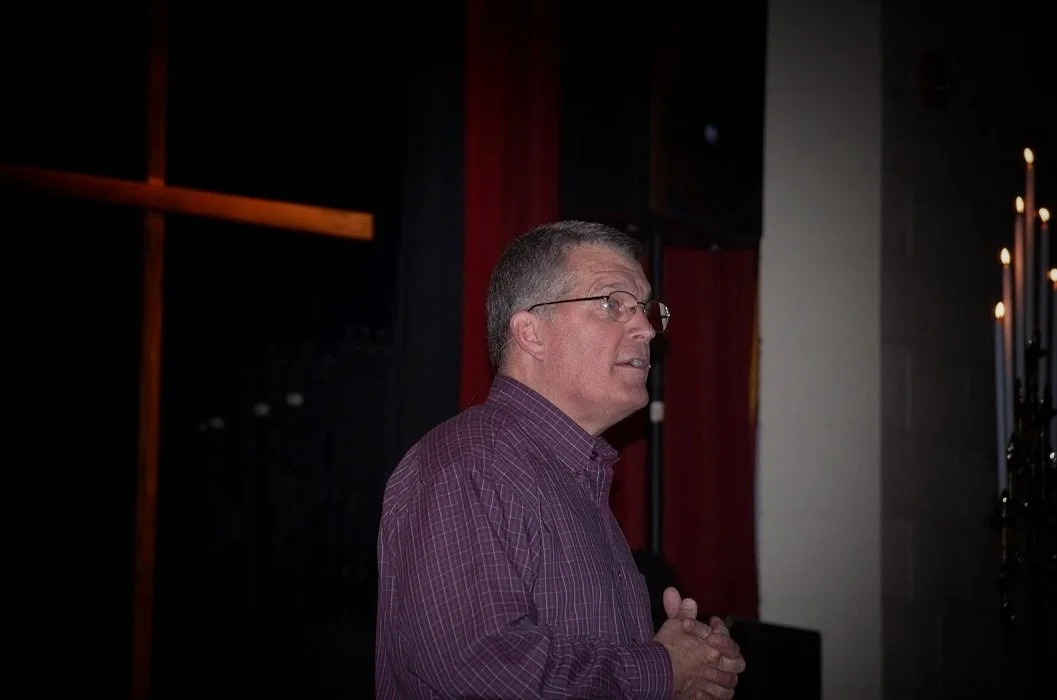
Faith Looking Forward - Hebrews 11:8-12 - October 4, 2026 - Jay Rabon
/In a rich exposition of Hebrews 11:8-12, Jay Rabon draws our attention to Abraham — the longest and most detailed example of faith in the entire "Hall of Faith" — and unpacks four defining Marks of a life lived by faith. Abraham was not chosen because of anything special within himself, but solely by God's sovereign grace. He was, in fact, a pagan idol worshiper when God called him, just as Joshua 22:2-3 reminds us: "Long ago your fathers lived beyond the Euphrates...and they served other gods." This is the pattern for all of us — faith begins not with our seeking God, but with God revealing Himself to those lost in sin.
Jay traces Abraham's journey through four movements: faith that obeys God's call into the unknown, faith that lives as a sojourner and pilgrim rather than settling into this world as a permanent home, faith that looks forward to the eternal city whose designer and builder is God (Heb. 11:10), and faith that trusts God's promises even when they seem humanly impossible. Abraham and Sarah both laughed, both wavered, and yet Hebrews tells us plainly that Sarah "considered him faithful who had promised" (Heb. 11:11). The fulfillment of God's promises, Jay reminds us, does not depend on the depth or strength of our faith, but on the faithfulness of God.
Woven throughout the sermon is a pointed pastoral challenge aimed at those who might be tempted to shrink back or retreat from their faith in Christ. Just as the original recipients of Hebrews were tempted to return to the old covenant, Jay asks us plainly: why would we go backward when Abraham and all the saints of redemptive history were pressing forward toward what we now possess in Jesus Christ? The call is clear — cling to Christ, hold fast to the promises, and forge ahead, because He who promised is faithful.
Transcript
Well, of all the studies of the life of faith in Hebrews 11, the longest. So it's the longest and the most involved is that of Abraham, the patriarch of Israel. His is also one of the longer accounts in the Old Testament. So not only in chapter 11, but one of the longer accounts in the Old Testament, running in the Old Testament from chapters 12 to 25 in the book of Genesis. It is in the Old Testament that he is the first person to be specifically commended for his Faith. Right.
"Abram believed the Lord, and he the Lord counted it to him as righteousness." - Genesis 15:6
In the New Testament, Abraham provides the example of faith par excellence. The apostle Paul particularly emphasizes Abraham as the model for Faith. In Romans 4:11, Paul gives Abraham the important distinction,
"the father of all who believe." - Romans 4:11
In Galatians 3:7, Paul says,
"It is those of faith who are sons and daughters of Abraham. It is those of faith who are sons and daughters of Abraham." - Galatians 3:7
Thus, brothers and sisters here this morning, if you are in Christ. If we are in Christ. We are the spiritual offspring promised by God to to Abraham. We are the spiritual offspring in Christ promised by God to our father Abraham. And his faith provides a model we are bound to follow. Abraham's faith provides a model for us to follow. So given all of this, we're not surprised that the writer or preacher of Hebrews pays so much attention to to Abraham in verses 8 through 19 are almost exclusively devoted to his faith and the author's comments on it. He singles out the highlights of Abraham's life, beginning with his call to leave Mesopotamia and culminating with his willingness to sacrifice Isaac at God's command.
At every given point of Abraham responded to the promise of God with unwavering obedience. And that is the writer's chief point. God promised Abraham a land, a prosperity or seed, a great name and universal influence. In fact, we are part of that influence today. Amen. The reason that we're here. Abraham believed God. He left his and I would say for us in the south, kinfolk, maybe some other places left his family left his kinfolk, his present comforts. Now remember, he's 75 years old. When he does this, he leaves his present comforts and prospects and at that age of 75, he sets out really into the unknown.
We'll talk about that. The unknown is toward the land of what? Canaan. Right? The land really ultimately to the land of Canaan, where he had never been before or never visited. And get this, when he got there, he lived as a resident alien. When he got to the land of Canaan, the land that was promised to him, he lived as a resident alien. And while he did not physically experience the fulfillment of the promises in his lifetime, listen, he looked forward by faith to see the ultimate fulfillment of the promises in Jesus Christ. And this is a major point in this section of Chapter 11, major point for these hall of Famer famers or hall of Faithers, this idea of looking forward in faith. Many writers or preachers of this section tend to look at the roll call of faith in this passage and say, look at these great examples. Imitate them. And for sure we are to look at these great examples and imitate them. However, as important as that might be, there is another critical point the preacher of Hebrew Cruz is making. So hang tight with me here. This is the point that he's making.
Remember, I think Kerry said he's writing to a people who are, what, wavering in their faith. And what are they doing? What are they thinking about doing? They're thinking about going back. Going back to what? To the law, to the Old Testament, to the O, to the covenantal sacrifices. They were tempted to go back to their old ways and thus forsake the truth that is in Jesus Christ. In essence, here's what the writer is saying to us, to them and to us. Why do you want to go back to the old ways, to the old covenant? Listen, your fathers, Abraham, were looking forward by faith to what you now possess. See that? Why do you want to go back when Abraham was looking forward to what you now possess in Jesus Christ? Why would you want to go back since what you have now fulfills their expectations? What we have fulfills their expectations. The writer is not simply saying do as they did, but it's helping us to see that throughout redemptive history, faith has always been forward, looking forward, looking.
Pastor David preached on this. I think it was last week from chapter 10, verse 39.
"We are not of those who shrink back and are destroyed, but those who have faith and preserve their souls." - Hebrews 10:39
True faith has been and still is persevering faith, fixed and determined by those promises of future things. Not yet seen with the eyes of flesh. Going to ask this question again for each one of us. I'd like for you just ponder in your hearts right now, why would we go back when all of the saints of redemptive history have forged ahead and have kept their eye on the invisible yet certain reality of God's promises in Christ? I raise that for us right at the beginning, because I'll raise it again. Why would we go back when all along all these saints have forged ahead? So, heavenly Father, Lord, I just. Just thank you for this, this opportunity this morning. Lord, we just praise your name, these wonderful songs that we've lifted up to you, that glorify you. And Lord, now I just would. I would pray even for myself, Lord, that we would have open ears and open hearts, open minds, Lord, that as we read and hear your word, that it might challenge us, that it might encourage us. But most importantly, Lord, that it would change us and it would draw us closer to you. In your name we pray. Amen.
So, four things faith does. So let's look at the first one. Faith responds to God's call. Faith responds to God's call. Hebrews, chapter 11, verse 8. And I think we might have it on the board. Let's read it together.
"By faith," - Hebrews 11:8
We learn right off the bat about Abraham's call, God's call to Abraham call and promise. And we see it in Genesis, chapter one, chapter 12, verses one through three. And let's read this one together. This is God calling to Abraham. Let's go now.
"The Lord said to Abram, go from your country and your kindred and your father's house to the land that I will show you. And I will make of you a great nation. And I will bless you and make your name great so that you will be a blessing. I will bless those who bless you. And him who dishonors you, I will curse. And in you all the families of the earth shall be blessed." - Genesis 12:1-3
Now here's something very important to understand right off the bat. That Abraham was not called by God and not given this promise because there was anything special about him. He was not called because there was anything special about him. But by the virtue solely of God's sovereign grace and choice. He was not called because of anything in himself. He was not singled out because of his faith, but because of God's grace. In fact, Joshua 22, 2 and 3 makes this clear. Where Joshua said,
"long ago your fathers lived beyond the Euphrates Terah, the father of Abraham and Nahor, and they served other gods. Imagine that and they served other gods. And then I took your father Abraham from beyond the river and led him through all the land of Canaan and made his offspring many." - Joshua 22:2-3
Abraham was not even seeking God. He might. I don't even know if he knew of the real God because he was worshiping other gods. He was a pagan idol worshiper. When God called him, that's who he was. That's what he did. Abraham was saved then because God sought him. His faith was preceded by God's call and responded to God's call, a call that came by grace alone, by God's sovereign choice. And Pastor James Boice applies this example to us. Let's look at what James Boice says
"in the way God called Abraham, God calls all who become his children. God comes to us when we are hopelessly lost in sin and without knowledge of him. This is a universal fact in the spiritual biography of Christians." - James Boice
And our response, brothers and sisters, is nothing more than belief in God and his promises. God calls us. The life of faith begins when God reveals himself to us. In Abraham's case, it was divine visitation. You could, you know, if we had time, you could say what it was for you, right? You can remember. For some, it was God's word being preached. You heard his word being preached, and the Lord drew you to him, or opening the Bible. It may begin by seeing someone, something Christ like in the life of another person. But in every case, faith begins with God revealing, revealing himself to someone lost in sin, ignorant of and unconcerned about him. And that's what we were before God came to us. We see here also from this scripture what faith requires. And what it requires is obedience born of trust.
It's God's call when we're not looking. And in obedience born of trust. Why do I say that God called Abraham? To do what? Leave. He'd lived in that area for 75 years. He said leave. He had to leave his home, his family, his prospects for life to go where God had called him. Now, listen, the Mesopotamian world at that time was not like western North Carolina at this time. Or even if the Lord had potentially calls me, said jay, I want you to leave Morganton and go to, I don't know, Honolulu. It's not like that now. For me, it would just be an airplane flight. But for them it would have been dangerous. It's not like it was safe to go out into these areas by yourself. So he didn't have the physical protection when he went out on God's call. And the other thing is this can you imagine? He's been there 75 years. He's got all these comforts. He knows all these people. Could you imagine some of his friends asking, asking him, where are you going? What are you doing? Why are you giving up everything that you have here? All these pleasures, all these comforts? Why would you do that? This one, I don't know if you've heard this one. Why are you throwing your life away to follow this God? Even know this person? He's not like the gods we worship. Why?
And not only that, get this, that God, when God called him out, he didn't even know where he was going. He calls him to leave his family to go where God calls him. And he didn't even know where it was. He didn't have a crystal clear plan. He didn't have a vision mapped out where he would be in five or 10 years. You know how we do that? We map out our lives. This is where I'm going to be in five or 10 years. We do all that especially maybe I did it in business. Rather listen. He met God. He heard God's call. And at truly great cost to himself. Frank and surely with much perplexity, he obeyed and he went. And so it is, brothers and sisters, with everyone who would be saved. God calls us not merely to believe some abstract facts, but to obey his call and to follow him wherever he leads. And even if the path ahead is not clear.
I was driving home the other night in the dark. And you know when you drive home, you have these headlights that are out in front of you. Well, the thing about the headlights is they illuminate the road well, right. Well, maybe right in front of you. They illuminate the road well, right in front of you. But the headlights don't show you. What, the entire road. They show you some of the road, but not the entire road. They don't show you the entire way ahead. Walking by faith often means to walk into the unknown. In such a situation, we trust God in the dark when we are doing what he said for us to do. Abraham stepped out into the unknown. But listen, he did not step out alone. God said in Genesis 15:1,
"Fear not, Abram, for I will be your shield. I will go with you." - Genesis 15:1
And what does Jesus Christ promise us in Matthew 28:2? What does he say?
"And I will be with you always. Even to." - Matthew 28:2
God, who promised to be Abraham's shield, promises to be our shield in Jesus Christ.
So God's called faith responds to God's call. The second bullet point. Faith lives as A pilgrim faith lives as a pilgrim. The call to faith is always followed by the life of faith. The same principle by which we are saved enables us to live to saved people. Thus we find this description of Abraham's life in the land of Canaan. So what was his life like in the Land of Canaan? Verse 9.
"By faith he went to live in the land of promise, as in a foreign land. Living in tents. He didn't say. Living in castles, living in tents with Isaac and Jacob, heirs with him of the same promise." - Hebrews 11:9
Now, we're not going to take time for it. But it took a while for Abraham to get to Canaan. You can read about it in chapters 12 through 25. It took a while. By fits and starts, he finally arrived. He arrives into the land that is promised to possess. However, when he got there, what did he find? It was inhabited by Canaanites and idolatrous people who did not know the Lord. By faith. He lived there not as an owner, but as a stranger in a foreign land. He lived as a sojourner, as a resident alien in the very land God had promised that he would own. Can you imagine that? God has called him there? He's living there. He lives in tents, because he is a sojourner, a resident alien of this whole land. And this presents the classic picture of the life of faith for us, for you and for me. We have great promises from God which belong to us now, but in large part have not been manifested in our experience. Abraham went to the land promised him, but when he got there, it did not belong to him.
This shows us the already that not yet character of the life of faith. We possess the promises already, but they are not consumed or consummated in our lifetime. And this is what the author is saying in Hebrews 11, right at the beginning, where he says, faith is the evidence, the possessions of things not seen. Brothers and sisters, we live this life in a world that is not our own, as pilgrims rather than as possessors, as strangers living in an alien country. This means that we do not belong to this world, but to another. The Apostle Paul in Philippians 3:20 says,
"Our citizenship is in heaven, and we eagerly await a savior from there, the Lord Jesus Christ." - Philippians 3:20
Our allegiance belongs to another realm, and being a pilgrim means that we do not love the things of this world. I'll say it again for all of us, especially for me, this is this steps all over my toes. It probably doesn't affect y', all, but it steps all over my toes. Being a pilgrim means we do not Love the things of this world. Colossians 3, chapter 3:1 through 3 says,
"if then you have been raised with Christ, seek the things that are above where Christ is seated at the right hand of God." - Colossians 3:1-3
The Puritan Jeremiah Burroughs gives us this helpful admonition about being pilgrims, about being sojourners. And let's read this one together, because it's a little longer.
"The scripture tells us plainly, as pilgrims and strangers. Consider you are pilgrims and strangers, so do not think to satisfy yourselves here. So let us not be troubled when we see that other people have great wealth, but we have not. Why we are going away to another country. You are, as it were, only lodging here for a night. If you were to live a hundred years in comparison to eternity, it is not as much as a night. It is though you were traveling and had come to an end." - Jeremiah Burroughs
We need to feed our faith upon the promises of God delighting in his boundless love for us, and not upon the temporary nature of this world. Feed your faith upon the boundless, so wonderful promises of God, and not upon the temporary nature of this world.
Well, verse nine actually leads into verse ten, one of the most well known verses and celebrated verses in the Scripture. So Abraham lives as a pilgrim, lives in tents, not in buildings, lives in temporary structures, and faith looks beyond what is seen. Verse 10.
"For he was looking forward to the city that has foundations, whose designer and builder is God." - Hebrews 11:10
There we get this word. He is looking forward to the city whose foundations and designer is God. This tells us what kept Abraham going all those years living in tents in Canaan. All those years not seeing or experiencing the promise, because he was looking forward to the heavenly city of God. He was looking to what was coming, not contenting himself on the offerings of the world, not sacrificing his inheritance for the refuse of a dying humanity. He was looking forward. His heart was in the city to come, and he placed his hopes there by faith in God. He applied this situation to what we might call the eternal perspective, which is something that we should all have. And really that's born in our hearts, if we're in Christ, is we have this eternal perspective, and this is how our lives are sustained in the midst of difficulty and trial, is that we are always looking forward to that city of God ourselves.
And we can find that in Revelation 21, which we'll share in a moment. But this is what John MacArthur said about that. The Christian, he said, is
"Willing to forsake the present glory, comfort and satisfaction of this present world for the future glory that is in Christ. In contrast to the buy now, pay later attitude prevalent in the world, buy now, pay later attitude prevalent in the world, the Christian is willing to pay now and to receive later." - John MacArthur
What makes Christians willing to make such sacrifices? Hope based on faith that the future holds something far better than the present. Paul writes in Romans 8:18.
"I consider that the sufferings of this present time are not worthy to be compared with glory that is to be revealed in us." - Romans 8:18
And this is our hope. I mean, Clint, I put a picture of the. The heaven, and I have a picture. I've tried to find an image of the heavenly city that we look forward to. And this image is this. This image can't even touch, can't even compare. But this is the best that we can, that we can do with our earthly eyesight. But listen, this is the city that Abraham was ultimately looking forward to. So that means this is the city that we look forward to. This is the city that sustains our faith in difficult times. Looking forward, not backwards. We look forward.
And here's how John describes it. Listen to this. In Revelation 21, in verse 10, he said he looked and
"saw in the holy city Jerusalem coming down out of heaven from God." - Revelation 21:10
In verse 11, we are told that this heavenly city shines,
"having the glory of God. It's radiant. It's like a most rare jewel, like a Jasper, clear as crystal." - Revelation 21:11
In verse 23,
"this city has no need of sun or moon to shine on it, for the glory of God gives it light. And its lamp is the Lamb." - Revelation 21:23
The most important thing about this city, about what we look forward to as we live as sojourners here, here's the most important thing. That we will be with God, and he will wipe away every tear from our eyes. And death shall be no more. Neither shall there be mourning, nor crying, nor pain anymore. How painful that is for many of us who are going through painful times. But we look forward and the scripture tells us there'll be no mourning, no more crying, no more pain anymore. For the former things have passed away. This is our destination, our true home. May we, like Abraham, look forward in faith to this city with hearts full of hope and joy, gratitude and thanksgiving. How could we not look forward in that way?
Well, finally. Bullet four. Faith trusts God when the promises seem impossible. Faith trusts God when the promises seem impossible. This is verses 11 and 12.
"By faith, Sarah herself received power to conceive even when she was past the since she has considered him faithful, who had promised. Therefore, from one man in him as good as dead were born descendants, as many as the stars of heaven that includes us, and as many as innumerable grains of the sand and the seashore." - Hebrews 11:11-12
That faith rests on the promises of God is especially clear regarding Isaac's birth. Sarah received power to conceive even when she was past age, 90 years old, since she considered him faithful, who had promised. Now, the Gospel is always preaching revisionist history to Old Testament saints. And the reason I say that, including David, Abraham, Sarah, because when we saw, say, Old Testament saints, they were sinners, just like we are. But the Gospel preaches revisionist history in Christ because he has come and has covered that sin. So here's the thing. As we close out this section, in this section, I want you all to do this. We should take heart here, because as we go back and look at Sarah, would we not say, just being honest, that Sarah doubted? Will we not say that she probably doubted? Maybe she just struggled believing that. She definitely wavered and potentially faltered. So would we not say that?
Well, let's just look real fast at how it all came down in chapter 12 of Genesis. Look real fast. All right, here we go. God called Abram, chapter 12, verse 1. He called Abram to go out. He gave him the promise. He called him out. Abraham, or Abram was 75. That meant if Sarah was 90 when she had Isaac, she is 65. So he calls them to go out. He's 75. 65. He says, you're going to have this son, the child of promise. Well, let's fast forward. Stick with me 11 years to Genesis 16. 11 years. 11 years. Genesis 16. Abraham is 86. And what do we have? No child of promise. 11 years later, he is 86. No child of promise.
So what do Abraham and Sarah do? What do they do that typically like, things that at least I do. Y' all probably don't do this. What do they do? Well, they're like, hey, we'll help God. Have y' all ever thought of that? We'll just help him fulfill the promise. Y' all ever done that? You never done it. I will help you, God. We'll help you fulfill the promise. So Sarah gives Abraham Hagar, right, her servant. And Ishmael was born. Well, did that work out? I would say there's still some problems from that. So. But we're going to help you, God. We'll help you out.
Well, that. That didn't quite do it. Let's Fast forward another 13 years to Genesis 17. Abraham is now 99 years old. Still no child of promise. Dude's got to be tired. Sarah's got to be tired. Get this, though. When he was 99, you can look it up. God comes to him and says, abram, your name is no longer going to be Abram. It's going to be Abraham. He's 99 from exalted Father, or we'll call it Father of Many to Father of Many peoples or nations. Dude. The Lord changes his name to Father of many peoples and Nations. And then the Lord did something. It's unthinkable. He changed Sarai's name to Sarah. Sarai is the possessive. My princes, Abraham's princes. Maybe a family's princes, but not Sarah. Sarah. The possessive is removed, and it just means princess. The Lord has changed her name to give her universal significance. And then God reaffirmed his promise to Abraham's family right there in Genesis 17:16, where he said,
"I will bless her, Sarah. Now she's 90. Indeed. I will give you a son by her. I will bless her. She will produce nations, and Kings of peoples will come from her." - Genesis 17:16
Amen. Well, what did Abraham do when God said this to him? What? He laughed. Ah. How could this be? I'm 99 and she's 90 years old. How is that going to happen? Well, then Genesis 18 comes along, and the Lord again appears to Abraham and says, hey, Abraham, by this time next year, a baby will be born to Sarah. And Sarah heard it and she just shouted, hallelujah. Right? She was. Oh, I can't wait. I'm all in. Thank goodness. What did Sarah do? She laughed, Frank. She laughed. She laughed. Now she denied that she laughed. Oh, but you know, I hate to inform all of us, but the Lord sees everything we do. She denied that she left, but the Lord had known what she did. But here's the other thing. The Lord swore that she would have a son.
And this shows us two things of great importance. This is good news for all of us. First, the fulfillment of God's promises does not depend upon the depth or strength of our faith. Right. The fulfillment of his promises to you does not depend on the depth or strength your faith, but upon the faithfulness of God. Pastor David has said this before. It's not the strength of our faith that saves us, but it's the object of our faith that saves us. And who's the object of our faith? Jesus. So that's good news. If you struggle, if you waver, you just go back and look at Sarah. And you know that God's promises don't depend on you.
And then secondly, faith clings to the promise. And yet true faith may be stronger or weaker at various moments in our lives. Faith clings to the promise. We cling to the promise. Sometimes barely, but we cling to the promise. Our faith sometimes wavers. Sarah initially faltered, but the text tells us plainly that she considered him God faithful who promised. Faith relies on the promise. Faith relies on the promise. Your faith relies on the promise. Both Abraham and Sarah were called to ignore their age and circumstances and trust in the power of God to fulfill his promise. She was barren and he was as good as dead. But together they experienced the real but unseen power of God in the present through the birth of Isaac. She was barren. Abraham was dead, basically. And that leads us to verse 12. Here we see that certainty of the promise on which faith relies on.
"Therefore, from one man and him as good as dead were born descendants as many as the stars of heaven and as innumerable grains of sand." - Hebrews 11:12
Listen. God promised, and there it stood. He promised and there it stood. The fact that Abraham had a 100-year-old body and that Sarah was long past the age of childbearing did not hinder the promise of God. God had promised that the line of electing grace would run through Isaac. And so it did not matter to the sovereign God of the universe. Abraham was as good as dead, did not matter. And it doesn't matter to us. And for us, God, our faith relies on the promise. And moreover, God's promise went beyond the land underneath the patriarch's feet. Abraham, Isaac and Jacob died without seeing their descendants possess the land. But never, at any point in redemptive history did the land embody the fullness of God's promise. Never has the land that was promised embodied the full promises of God. The land itself pointed to a greater land of rest for the people of God.
The writer, in essence again says to those who he wrote, do you want to go back? Do you want to go back? Abraham was moving forward to the promised blessings that you now possess in Christ. He was pressing on to the tangible reality of what awaits you in the new heavens and the new earth. The patriarch's homeland was not merely Palestine, nor ultimately their homeland, and yours and mine is entirely in the new heavens and earth. So, four things that faith relies on. First, faith responds to God's call. Faith is the life changing, obedient response to God's call. Second, faith lives as a pilgrim. Faith refuses to make this present world our permanent home. Faith refuses that. It refuses to make this world our permanent home. Third, faith looks beyond what is seen. Faith views life from an eternal perspective, looking forward to that city that has foundations, whose designer and builder is God. And faith trusts God when the promise seems impossible. Faith trusts God when the promise seems impossible. The fulfillment of God's promise does not depend upon the depth or strength of our faith, but upon the faithfulness of God. And I'm going to return to that question. I asked this before. Are we moving forward in faith? Are you moving forward in faith? Are we forging ahead with all the saints of redemptive history, keeping our eye on the invisible yet certain realities of God's promises to us in Christ or brothers and sisters? Are we tempted, for whatever reason to go backwards? They could be good reasons, but for whatever reason, are we tempted to go backward? My encouragement and challenge to us as I close is this Cling to Christ, don't shrink back, hold on to the promises, because he, Jesus Christ, who has promised, is faithful. Amen.