
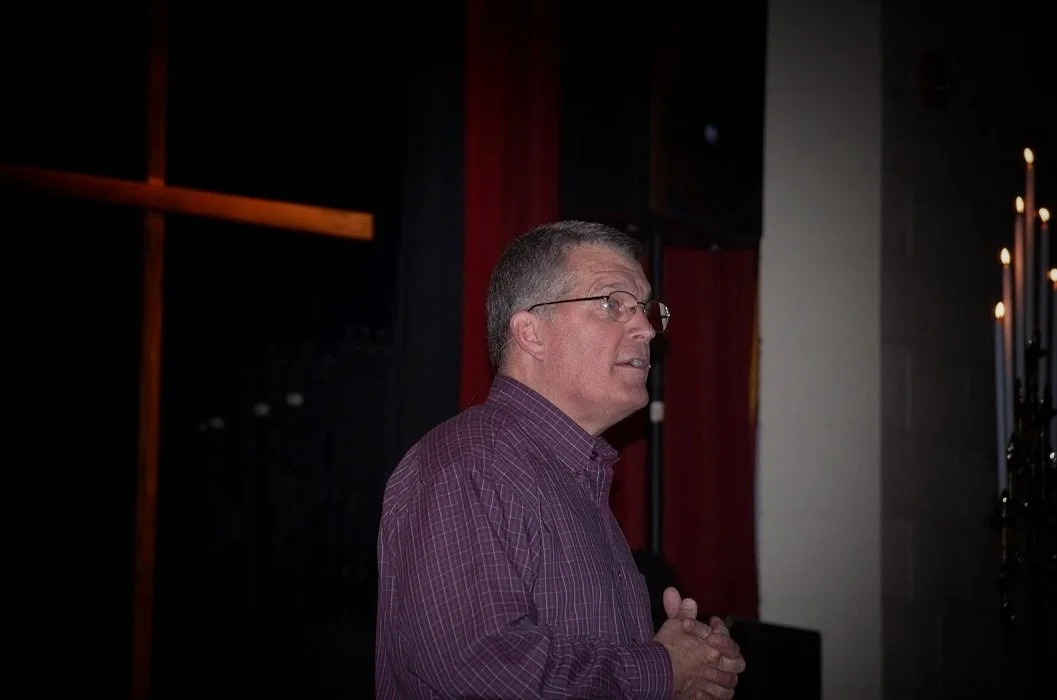
I’ll Get Back to You - Hebrews 10:19-25 - September 6, 2026 - Rick Sutherland
/Rick Sutherland opens by grounding the entire sermon in the "since/then" logic of Hebrews 10:19-25 — two foundational facts that change everything. First, because of Christ's torn flesh, the curtain is gone and believers now have unrestricted access to the holy places. Second, Christ is our great high priest, eternally interceding, empathetic to our weakness, and the guarantor of every promise we've been given. These aren't merely theological statements to be admired — they are divine realities that demand a response.
That response unfolds in three "let us" commands. We are called to draw near with a true heart — not the duplicative, lip-service religion Jesus confronts in Mark 7:6, but a genuine heart toward God, others, and ourselves. We are called to hold fast our confession of hope without wavering, trusting that "the one who promised is faithful" (Heb. 10:23), even when doubt shows up at the door and we grow tired of waiting. And we are called to stir one another up to love and good works by living in real, transparent, burden-bearing community — not attending church to check a box, but gathering with a genuine heart desire to worship and walk alongside God's people.
The sermon closes with a penetrating application: will you be shepherded? Drawing on the rich imagery of Psalm 23, Rick reminds Gateway that the great shepherd provides, restores, guides, protects, and pursues — and that the whole of the Christian life is a daily surrender to that shepherding. The unrestricted access Christ has secured is only of value when we walk in it, and we cannot walk in it alone.
Transcript
Good morning, Gateway. I hope you have a good memory of our praise and prayer time from just a couple minutes ago because God definitely has a message for us today. What you just heard from your brothers and sisters, you're getting ready to hear again exegeted from God's word. And as I was sitting there listening to those themes and those testimonies, it's like, all right, God, thank you. This is what you have for this church today. So our text this morning is Hebrews 10:19-25. Hebrews 10:19-25. These are God's words.
"Therefore, brothers, since we have confidence to enter the holy places by the blood of Jesus, by the new and living way that he opened for us through the curtain that is through his flesh, and since we have a great high priest over the house of God, let us draw near with a true heart in full assurance of faith. With our hearts sprinkled clean from an evil conscience and our bodies washed with pure water. Let us hold fast the confession of our hope without wavering, for he who promised is faithful. And let us consider how to stir up one another to love and good works, not neglecting to meet together, as is the habit of some, but encouraging one another. And all the more as you see the day drawing near." - Hebrews 10:19-25
God, thank you for your words. Thank you for your spirit that shines lights on these words, presses them into our hearts, opens our minds to their meaning and uses them to make us like Jesus. Thank you for what you have for us to hear from your words today. Thank you for preparing the way through worship song, testimony, scripture. And as we spend minutes now in these divine inspired words that you've given to us, God, will you multiply the weight of this truth and the meaning you have for us this morning? We ask this in the name of our Savior, the Christ. Amen.
So last week I was really blessed and I enjoyed the way that Brad handled that text. It was a little intriguing to me how he worked his sermon points backwards, right from four leading up to zero, ground zero, his last point, that we now have a priest, we have sanctification, we have propitiation, all in. And because of Christ, also, as a former fellow Baptist, he showed me it's all right to break free from my Baptist roots and get a little creative with my outline. My dad preacher for years, three points alliteration. And I'm going to break free of that a little bit this morning. So that's why the title of my sermon this morning is I'm going to get back to you because I'm going To give it to you at the very end as the application. It's not a gimmick. I'm not trying to one up, Brad. It really has a purpose that I think you'll see our text in verse 19 this morning. And Brad alluded to this last week. It starts with a therefore. This particular therefore is pointing us back in this sermon, in this letter to chapter seven and verse one. We've been in that section. We've crossed a milestone. Now completing this section that we started back in. Does anyone have a guess? May. In May. We've been in this section since May. Some of you may be thinking, I feel like we hear the same thing week after week. And I think that means God has a message for us week after week, right?
We have been studying the supremacy of Christ's priesthood, and now we reach a milestone at verse 19. And the preacher here in Hebrews uses a literary device called enthymeme. Enthymeme. How many of you guys remember that from freshman English? Yeah. I have no idea. I knew when I was studying that it was a literary device. Had no idea what it was. So I looked up that word. Don't think that I knew that one. But enthymeme, if you want to drop that in a conversation this week, make sure you check with Taryn to make sure we're using that. Right. But enthymeme is a logical statement. It's a logical statement based on a since then construction. Okay. In a practical sense. Have you ever played this game with your family? I play this game on the weekends. I'm doing a project. I'll stop on like Thursday and get all the stuff that I need for a project. And invariably I either miss something or I buy the wrong thing. Three weeks ago, I was doing a gutter project and I bought a corner piece that went this way and I needed one that went this way. And I looked at it and tried to turn it upside down. There was no way it was going to work, Right. This was a game of Tetris. I wasn't going to win. So I put on my go to town clothes. I get the part, my receipt. I'm gonna go to Lowe's and switch it out. And somebody in my family hits me with a hey, since you have to go to the store, can you. Right? Can you? And their can you. I'm like, your can you is this direction, and I'm going this direction.
Or maybe if we apply this to sports, maybe you follow a sports team and you draft somebody or you sign somebody. So you're talking with a friend who's also a fan of that team, and they hit you with, hey, since we now have are we going to or this is our year or something like that, right? When you have enthymeme and you have these since and then statements, the first part of the exercise is always to determine whether or not you agree with the sense statement right before you even get to the then part of changes it. It makes it a little different. When the sense statement is divinely inspired, when it's truth from God and it's given as a presuppositional fact, it cuts the legs out from under our ability to evaluate or argue with the sense statement, and it turns our attention then to the then part of the argument in our text. Today we have two of these sense statements.
Let's look at them. First, in verse 19, we're told that it's a fact, it's a fact that we can have confidence to enter the holy places by the blood of Christ. This is what we have been in since chapter seven. And again last week, over and over, we're reminded of the Old Testament sacrificial system that the recipients of this sermon, this letter, the Jews, had been under. Remember, Brad taught us there was a perfect sacrifice, finally by a perfect person that everything had been pointing toward. And this sacrifice fundamentally changed the requirement and the reality that we needed an earthly system of priests and temporal covering of animal blood to cover our sins. Because of Jesus and the fact that his perfect flesh was broken and sacrificed, we now have unrestricted access. We have unrestricted access to the heavenly places, and we can boldly enter them where they're used to hang a physical curtain. We've talked about that often. The curtain is gone, it's been torn. And we are commanded and drawn to boldly draw near the throne.
In practical terms, we can draw near the throne of grace with confidence to receive mercy, find grace in time of need. Going to let Hebrews preach a lot of this this morning. That's Hebrews 4:14. In theological terms, Christ entered once for all ahead of us, going through tearing the curtain, having his flesh torn for us, securing an eternal redemption for us by his own blood. Hebrews 9, 11 and 12. And unlike the system they were under in the Old Testament, this access we have is neither symbolic nor ritualistic, nor a sign of what is to come. Because the perfect has come, this now is unrestricted in real access to our Creator. What formerly would have been a death sentence to people under the Old Covenant is now our inheritance as sons and daughters of God, unrestricted access is only of value if you do what, if you utilize it, if you walk in it.
I grew up in Jacksonville, North Carolina, and there's a military base and it's the largest employer in the area. So in the morning and the evenings, there's a lot of traffic, right? It takes up the whole town, traffic going to and from the base. So I moved away from there a long time ago. And since I did, they've put in a series of bypasses to help control that traffic. And when I go back now, I don't recognize the roads or how to get anywhere. So I just flip on my Google Maps and it tells me how to get there, right? Because there's bypasses and on ramps and off ramps, and it really saves time. It gets you ahead of traffic and it saves time. My parents refused to use it. They've been driving the same way since 1970. They know how to get there using the same way. And they're not going to have anything to do with these newfangled bypasses, right? So they're of no value to them because they have shorter access, but they don't use it, right?
We have unrestricted access. We're drawn near to the throne, but it's of value only when we use it. Listen to what these Some more claims and promises from Hebrews and what we've been studying for Hebrews 10:19, 22, just in our text this week. It's Christ's flesh. It became the curtain. It was torn through his death in an open access to God's presence. This removed the barrier between God and man. Hebrews 6. Jesus has gone ahead as forerunner on our behalf, having become a high priest forever, meaning he continually provides the way of this open access. Hebrews 7. He is able to save us to the uttermost, those of us who draw near to God through Him, since he lives to make intercession for us. And then from our last study in Romans 5, through him we have obtained access by faith into this grace in which we now stand. Romans 5:2.
The second conclusory statement that we are told in our text this morning is, we have a great priest over the house of God. We use that term a lot, right? The house of God. The house of God. And we tend to come to think of it as the building we're in, right? The physical church that we're in. That isn't an error, but it's also not the truest form of what Scripture tells us. Because from Scripture, the house of God is is his people, his church, us. The high priest over God's people is Christ becoming priest over his church and having the authority and the oversight of the New Testament Church, which is also his bride. He is our king, our priest and our shepherd. He is our minister. He is our mediator.
From his position in his seat next to the Father, over and over we've seen where there was a Levitical priesthood that was temporal and had turnover, right? When we talked about Melchizedek, we talked about the Levitical system with turnover due to age and death. And yet Christ in His position is eternal. And the eternality of that position makes him the guarantor of the promises that we receive in his priesthood. In His New Covenant he continues forever, and he is able to save to the uttermost those who draw near again. Hebrews 7. He is also, we have studied and know, empathetic. He understands because he is the one who is in every respect tempted as we have been, and he has shown us how to do that in a sinless way. Hebrews 4:14 and 16 so this phrase, this sense statement, confirms the promises that we are under the vigilant care of a shepherd who has himself in himself, obtained our justification in himself, knows the struggles we walk in and experience, and through his blood, constantly advocates our justification before the throne of God. That's all divine and that's true. That is the sin statement. But we're still called to live and to walk in it. We're still called to utilize that access.
And now comes our duty. What are we called to do? What are the Let us statements in our text this morning? The first that we see is to draw near with a true heart in full assurance of faith. We're told in Ephesians and we're told in John, and this was mentioned in worship through Christ. We both have access in one spirit to the Father. Ephesians 2:18 and nobody comes to the Father except through Jesus. John 14:6 beyond just the intellectual knowledge that we have a God over us, and beyond a promise that the Old Covenant people were under, that we would one day have access to this God, what we now have is a bold yet humble, a reverent but expectant, a genuine access to God that is grounded in the promise that Jesus has already secured the way for us. That statement would have been unfathomable to the Jews who were raised in the expectation that nearness to the presence of God equaled death. But Ephesians 2:13 tells us those who were once far off have been brought near by the blood of Christ.
What is a true heart in full assurance? A true heart is one that is not duplicative. Having a true heart rules out lip service and rules out outward performance. A true heart doesn't claim that it rests in grace, but then actually puts their hope in religious service or cynicism. Go with me over to Mark 7, because Jesus addresses this very plainly. Very clearly. Jesus shows us he has very strong feelings about these type of duplicative hearts. Mark 7. 1.
"The Pharisees gathered to him. With them were some of the scribes who had come from Jerusalem. And they observed, they saw that Jesus disciples ate with hands that were defiled. That is, they had not washed. The Pharisees and all the Jews don't eat unless they wash their hands properly holding to the tradition of the elders, so that when they come from the Marketplace, they don't eat unless they wash. There are many other traditions that they observe, such as washing cups and pots and copper vessels and dining couches. So based on all that, the Pharisees asked Jesus, why do your disciples not walk according to the tradition of the elders? Why are they eating with defiled hands? Jesus answered their question. He said, well, did Isaiah prophesy of you hypocrites?" - Mark 7:1-6a
He takes scripture that they would know by heart, had memorized, had quoted to others. And he says to him, says to this group,
"this people honors me with their lips, but their heart is far from me." - Mark 7:6b
Listen to the weight of verse 7.
"In vain do they worship me, teaching as doctrine the commandments of men. You leave the commandment of God and you hold to the tradition of men." - Mark 7:7-8
One commentator that I was studying said that the this true heart, this call to have a true heart is threefold. We're to have a true heart toward God, a true heart toward others, and a true heart about ourselves. And Jesus uses this story in Mark 7 to show how these religious people fail all three prongs. They don't really care about what God wants for the people. They want compliance with their tradition. They don't care about the disciples. Right. They're not calling them to worship. They're upset because they're not following their traditions. And then they're calling out the disciples. And through the disciples, who are they ultimately calling out? The Master. Right. They're trying to call out Jesus. They're willing to completely overlook their own heart and the fact that they are putting their hope in tradition. They are, verse 7. Worshiping, vainly, teaching as doctrine the commandments of men. Failing all three prongs.
How many of you are Willing to admit that you can fake loving or serving other people, while at the same time completely overlooking the selfishness of your own heart. That's me, right? I can do that. And at the same time call out what I see in your heart. We're called to have a true heart toward God, toward others and about ourselves. We're also told, let us walk in this. The fact that our hearts are sprinkled clean and our bodies are washed. This study in Hebrews and these calls to obedience really bring into focus the Old Testament practice. It's really good to be studying and learning Hebrew with a good view or maybe a companion study of Levitical law. Because under the Old Covenant, the practices that are described and compared in Hebrews are all set aside for a better way in the Old Testament. Under the Old Covenant, we see that when people became ritually unclean, they had a list of ceremonies they had to go through. It was essentially a checklist that involves sacrifice and shedding of blood. But if you look at Leviticus 14 also, the people, buildings and objects had to be sprinkled with blood, had to have the blood sprinkled and cast on them. And as with the other ceremonies and rituals in the Old Testament, this was not heart cleanliness. This was obedience, and this was ritualistic cleanliness.
But in Christ, his sacrifice and blood. His blood penetrates past outward obedience and it penetrates to our conscience, our conscience, the arena of our guilt and shame. And Christ's blood provides a true cleansing from the guilt and shame that Satan wants to hold against us. And as the Holy Spirit gives us this new life, we receive Christ by faith. And we can rest in the eternal forgiveness that was secured by his finished work. This cleansing, this sprinkling, is the fruit of regeneration. Fruit of regeneration. It's the new life that Christ gives us by his sacrifice. Our hearts are sprinkled. How are our bodies washed again? Look back to the Old Covenant ritual. When Moses was told by God to commission Aaron and his sons for the priesthood, he had to sprinkle them with blood from a sacrifice, anoint them with oil, and then wash them with water before they were ready to serve. In the Old Testament, the blood is the covering of sin. And the washing for water prepares us for cleanliness and external ritual cleanliness. But then in the New Testament, through Jesus, we come and we see that he has fulfilled these shadows, all of these rituals that pointed to Him. He has fulfilled them. And now having our hearts sprinkled with his shed blood were delivered once and for all from a guilty conscience and Our bodies are washed pure with pure water, pointing to our baptism, which is the outward sign and seal of the definitive, not ritualistic, but the definitive cleansing that Christ accomplished in his death and resurrection.
Next, in our text, we're told to hold fast our confession of hope without wavering. Hold fast our confession of hope without wavering. This week, I had set aside some time on Tuesday night to study, and I was right here in this portion of the text. I had some commentaries open. I was reading some passages of scripture. I was working my way through this section, and I got a text from a family member. And it said, hey, can you call me somebody I really love, make time for in my life, and I know that they're in a rough season. And I said, hey, can I have 10 minutes? Let me work through this section, give you a call and listen to what God gave me during those 10 minutes. Okay? I was reading a commentary that said,
"The distinctive feature of hope is a desire for future good accompanied by the faith to trust in the outcome."
That's a pretty good working definition for believers. Our hope is not grounded in some uncertain quest, right? I mentioned a sports analogy. Football is getting ready to start. People have been practicing, adding recruits, signing, whether it's high school, college, everybody starting out on their season, right? They have a quest, they have goals, but it's uncertain, right? I can tell you, based on the team that I root for, their goals are always uncertain, right? But in Christ, our hope is not grounded in some unknown, uncertain outcome. It's grounded in the fact that God cannot lie and he is sovereign over his creation. If you can grasp those two facts and believe in them, then your hope can be unshakable. And our call, our present duty in this life is to walk in that hope day after day. But it's not without struggle. The future good that we are believing in are the facts that Jesus has defeated sin and death. And we're told that we will be in his presence, in God's presence, forever. We hope this, we believe in this, and we profess this in multiple ways. We profess it upward in worship, right? We profess it back to God in worship. We praise Him. We talk to our kind Father about the promises we're claiming. We profess it outward in how we live our lives and the hope that we demonstrate in how we live. And yet even in that, all of us suffer doubt on multiple different levels. But we can be sure that God's promises are going to come to pass.
And yet when we doubt God's promises, we become vulnerable to believing other truths that contradict what God has said. Believing as truth, deceptions. But in our passage, we see we're commanded, we're called, not to waver. Well, that's a good question. What is wavering? What does it look like? Who determines if I'm wavering? Well, this is what I came up with as a definition. Wavering begins with awareness of our own weakness. And when we see that weakness, rather than claiming Second Corinthians 12:9, his grace is sufficient for me, and his strength is made perfect in my weakness, rather than claiming that, we evaluate our own weakness and then combine that with a failure to trust God's strength and promises. And the human experience that we can all confess and agree to is that we grow tired of waiting. We can trust and believe in God if He answers our prayers the way that we want, by the deadline that we set. But when our expectations aren't met, doubt arrives on our doorstep. And either you chase that doubt away with scripture, hope in God, or you open the door and you invite doubt into the foyer.
That's the human experience. Satan is hoping for that. He wants to use doubt and hopelessness and grow it into wavering, into spiritual deterioration, into a dying prayer life, into abandonment of faith. You've probably seen that metastasize in some of your brothers and sisters. But the antidote to that, the treatment to that, is steadfastness rooted in assurance that God is faithful, willing, and able to fulfill all that he has promised. But we can't always provide that antidote on our own. All of us struggle, right? We confess that we hear that in each other. We all struggle, and none of us is called to fight this battle alone. That is one of the deceptions that we believe, that isolation. And that is why discipleship and community are so important and necessary in our lives. We preach the gospel of these truths to ourselves, but we also confess to our shepherds and our fellow brothers and sisters in Christ where and when our burden is heavy and when we need help. We know this is Biblical because Christ commanded us to bear each other's burdens and fulfill his command to us. And how can you carry my burden if I don't hand it to you?
Our text says it so plainly and powerfully. And this is the one truth all of us need to take away from this. This morning, the one who made these promises to us is faithful. That is the bedrock of hope. The one who made these promises is faithful. Now, I told you I got a text asking for a call after I got done writing Those paragraphs that I just shared with you to this manuscript. I answered that text and I called my family member. Sometimes you know right away that a phone call is going to be tough. The first sound I heard was sobbing. And my loved one said through the sobs, will you pray with me? They confessed their burden. They said, I have reached my breaking point. I can't take any more of this trial. I've been asking God to deliver me and my child. And they said, I'm starting to lose faith. And then they said, do you have any truth you can share with me? That was my response. It was hard for me not to laugh in that moment through my tears. Coincidence is when you wear the same shirt as a co worker. All right, that's coincidence. Divine appointment is our sovereign God having a decree over his whole creation, at the same time caring for us individually that he will pour into you so you can spill over into my need and burden. That we can go to God in His word, in his spirit, and be filled up to be a well to be drawn on when people need their burdens to be carried, which goes right into our next.
Let us how do we stir up each other to love and good works? There's at least two arenas that I could think of or see in this text related to stirring each other up. One is God acting and the other is based on us. So let's start with God. That seems like a better choice, right? That seems like the more dependable choice. And we've talked about it. Mark called us to it this morning. We stir each other up by prayer and asking God to move in each other's lives. And again, this is calling us to bear burdens in prayer. How do we know what to pray for? It's not that I look into your life and make a list of your weaknesses and pray about those. This is not about judging. This is about living in community, transparency, vulnerability, confessing our faults to each other so we know what to pray for. We know what to carry. My wife, my elders, my accountability partners, my life group. These are the people that should know my struggles, my besetting sins, and should be praying for me. Should be carrying that burden, should be lifting me up to become like Jesus in these areas. But remember, somebody cannot carry your burden until you hand it to them. And that is what we all struggle with. We're insular, we're proud. We believe we can do it on our own. I love this cooperative, the cooperative nature of what we're being called to do here. We confess to each other and Then each other. We carry these requests to Christ in both of us. We put our hope in God to change us and to shape us.
In addition to prayer, we also stir each other up through love and good works. And not only do we in this church and in our faith communities know that we're Christ followers, but so does the world. Right by our testimony, they know that we're Christ followers. And the Bible tells us that we show them that we are Christ's disciples by the love we have for each other. We encourage each other by sacrificial acts. And Brad taught us last week, this serving, this loving, this acting is not in any way to earn God's favor, but it's in response to Christ's sacrifice. What we hope to inspire and to encourage in each other and in others is the love and the kindness that we see in Christ. It's not a quality of our own. We're not asking people to be like us. We're saying, be like Christ. We call others to imitate Christ in how we live. We stir up those who are immature, those who are growing in Christ, those who are stuck, those who stumble, those who falter and waver. We stir up because it is a command and our text flows right into the next expectation that we stir each other up in our meeting together.
In our meeting together. So what is the expectation of meeting together? Where is that set and by whom? I grew up in a church in my childhood that met three times a week, two revivals a year, clockwork. That was the expectation for that church. Esther and I got married. We found our first church together, and it met on Sunday and on Wednesday night, and then had life groups. This church, we have a corporate service once a week on Sunday, and then we meet in life groups, in other meetings and groups throughout the week. So which of those is right? What is the expectation? And right up front, the answer is scripture doesn't give us a specific recipe or formula. Scripture gives us guidance about heart attitudes. What we can see is that the constant pattern from creation until now is that one day in seven is given for rest and for worship. That's clear. We observe this in this church through our Sunday corporate worship. We observe this on Sundays because the Christian church moved from a Saturday Sabbath to Sunday, when Christ rose from the grave on the first day of the week. But beyond that specific call for a day of rest and worship, Scripture also calls us to live in community, to walk with each other and to bear each other's burdens.
And in this call, I see two very specific ways that we're called from Scripture. The first is that we don't attend church once a week to check a box or to seek God's approval. Why going back to Mark? Because that would be serving God in vain. The call from Scripture is to have a genuine heart desire to be with God's people, to worship the Son. And that desire should be a primary driver of our choices of what we do with our time and our schedule. And the second is to have the type of heart that can be shepherded because there's latitude and there's grace within the guidelines of Scripture for local shepherds to decide how they're going to lead and feed their flocks. And it doesn't look the same for every church. At our church, we ask for three things. We ask you to meet together and worship when you're able. We ask you to be a regular part of a life group, a community group, and we ask you to have a ministry where you're serving others. Those three things. And of course, more than that, when and how you're able. If you don't submit to that request from your local shepherds, we're not going to say that you're sinning, because that would be legalism. But what is between you and God is the attitude of your heart in not submitting to your shepherds and the question of what choices do you make rather than gathering together. Because it's clear from Scripture that we meet together and we stir each other up. And those are not done in isolations.
As part of my prep, I reviewed two of Piper sermons on this passage. They were nine years apart, and in both of them he did the same exact thing. He took this passage and he used it as a call for his church, Bethlehem, for his people to live together in community and accountability in their small groups. He said, it's clear that we are to be together in corporate worship. And then what he was calling his people to was community in their small groups. And here's how he preached it from Deuteronomy 10, 12, 13.
"Israel. What does the Lord your God require of you but to fear the Lord your God? To walk in all his ways, to love him, to serve the Lord your God with all your heart and with all your soul, and to keep the commandments and the statutes of the Lord, which I am commanding you today for your good." - Deuteronomy 10:12-13
And then he said this.
"All the commandments of God are for our good. Do you believe that? Do you accept that God knows us better than we know ourselves? He knows. He knows. God knows what will make us deeply and permanently happy. We think we do, but we don't. We have to learn this from Him. His commands are for our good."
So once we're together and we're in community, how is it that we can encourage each other? I mentioned this above, but the ability to encourage each other presumes that we know each other. And it presumes we know the struggles that each of us is walking through. And this necessitates spending time together and sharing our lives together. That's how we can listen in to each other and be specific about how we can encourage in the Lord. Here's a number of thoughts we give verbal affirmation that the Lord is made perfect in our weakness. He is faithful to his promises and we give verbal affirmation of the ways that we can see Christ in each other. We share. We verbalize burdens and weaknesses. We repeat them back that we've heard from each other and commit that we're going to be in prayer for those for each other. We empathize by sharing shared emotions, sorrow, joy, weakness, doubt, insecurity and use all of those to point back to the hope that we have in Christ. And we provide the visible and tangible expressions of love when someone says, I need help moving something, I need to borrow something. Can somebody come over to our house and service in this way we listen to the call. Often these come through David or J, right? We listen to the call of other people's needs and we respond by giving up our time to serve other people. We hold each other accountable in humility. We're bold to call each other back from the cliff when there is sin. And in Second Corinthians we restore in grace when we stumble, because we all stumble.
And this isn't a one time effort. This isn't something you can do and say, all right, I heard that sermon. I checked that one off. This is how we live. This is how we stir each other up to good works. Last in our text today, how do we see the day approaching and what day is it? You may have thought one dimensionally about this and that's fine. I have at times as well. But if you will get your New Testament text and use your study tools sometime this week, you will see that there are multiple days of the Lord in the New Testament. Multiple days of the Lord. It's not solely a feature of Christ returning at some unknown date in the future, although that is true and that is one of them. The day of Christ does refer to his return, but it's also used in the New Testament to refer to Pentecost and the fall of Jerusalem and the destruction of the temple. And think about it, for this audience, a group of Jews in Jerusalem who this was preached to and delivered to as a letter, that day of the Lord was only two years away. That day of the Lord they were told to be watching for was only two years away. So it's not a moment in time in history. The day of the Lord is a reference to spiritual readiness. It's a reference to knowing and living our lives believing that God's promises are true, that God's return can happen at any time, and the awareness that we're living for a future kingdom and not for the temporal world around us.
So my application, my question, my title of this message is very simply, will you be shepherded? Will we be shepherded? That question is the primary call of our redeemed lives. Because that question asks, do you? Do I truly have a new master? This is not a partnership, God. I'll give you this section. I got this section. We can do this together. But that's how we like to live our Christian life or step down from this throne. I've got it for a while. When I need you, I'll put you back in charge. No, all of us have to preach this truth to ourselves every day. Who's in control of my life? Am I being shepherded by my great high priest? In application of today's text, will we believe and live in the promise that he's the new and living way that gives us access to God? And will we walk in that access? Will we accept this as a transforming truth and then obey what we're called to do in response? To live a life free of guilt and remorse, knowing my heart is sprinkled, I am washed in his sacrifice.
Do you hold fast without wavering, believing in the One who gave us the promises? Do you encourage others, live in community and live a life looking for Christ's coming? Arguably, one of the most well known passages in our Bible is Psalms 23. It's one of the few texts that transcends church and religiosity and will find its way into secular circumstances. Right? But it's rich and for believers, it's a passage we all know and love. And at its core, what it is is an amazing picture of the great shepherd. Because in that passage, if you break it down phrase at a time, you see, God does all the work. He provides completely. He gives rest, he leads to peace. He restores our souls, he guides in righteousness, he accompanies us through danger. He protects and comforts, he prepares a feast, he blesses and honors, he pursues with goodness. And finally he welcomes us into his presence. He's the great shepherd and that's his plan and his promise.
And this is what we are called to in and because of his perfect priesthood. But the question is, will we be shepherded into that? Jesus, thank you for these words week after week, the words that you have breathed out and given that call us to change, call us to emulate Christ, give us hope and God will you press into all of our hearts this truth and promise that the one who has called us and given us these promises is faithful. And even when that becomes hard and we waver and have doubt, you have a plan to shepherd us through that. You have a plan to use us in others lives, you have a plan to use others in our lives. And ultimately you have a plan to use these truths to keep us grounded, hoping and trusting in you. Thank you for what you have and what you are teaching us. Thank you that we get to celebrate that now at your table, Jesus. Amen.