From Shadow to Substance - Hebrews 10:1-10 - August 23, 2026 - Don Windmiller
/Drawing from Hebrews 10:1-10, Don Windmiller opens by establishing a foundational truth that runs throughout the entire book of Hebrews: Christ is better. Better than the prophets, the angels, Moses, the high priests, and — as this passage makes clear — better than the sacrifices of the Old Testament law. The ceremonial sacrificial system God gave Moses at Sinai was never meant to be the final answer. It was a shadow, a reflection of the substance that was coming. As Colossians 2:17 reminds us, "these are a shadow of the things to come, but the substance belongs to Christ." Just as a shadow is a real but incomplete image of the person casting it, the animal sacrifices were real but incomplete pictures of the perfect sacrifice to come. They were offered year after year, never fully clearing the conscience of the worshiper, never fully removing sin — only temporarily covering it.
Don carefully walks through why the blood of bulls and goats was always insufficient. Hebrews 10:3-4 makes it plain: "in these sacrifices, there is a reminder of sins every year. For it is impossible for the blood of bulls and goats to take away sin." These sacrifices were offered by imperfect priests, for imperfect worshipers, and could never bring them fully into the presence of God. The curtain separating the holy place from the holy of holies said, in effect, not yet. But when Jesus Christ — fully God and fully man — came in bodily form, in perfect obedience to the Father's will, everything changed. He did not merely cover sin; He removed it entirely, once for all. The curtain was torn from top to bottom, and God's message became clear: now you can come. By His will, and through the offering of His body, all who trust in Christ are sanctified — positionally made holy, declared righteous, and given an eternal inheritance kept safe in heaven.
Don closes with a warm and urgent call to respond. Recognizing that we are all sinners separated from God, that the wages of sin is death (Romans 6:23), and that no amount of human effort or religious ritual can bridge that gap, he points every listener to the only name under heaven by which we must be saved (Acts 4:12). Repentance and faith in the risen Christ is the doorway into this new life — a life Marked not by ritual, but by deep roots in God's Word, overflowing thankfulness, and a growing, joyful obedience to the One who gave everything for us.
Transcript
Jesus Christ, who died once for all. This world is not our home. We're just passing through. And he has prepared a place for us in heaven. As we know Jesus Christ as Lord and Savior, and as we study God's word together, it is all pointing to Christ and pointing to glory and to be with him forever.
Take your Bibles and turn to Hebrews, chapter 10.
For those young people as you're looking at the words and listening to the message, the three words today are shadow and sacrifice and blood. And as you write those down, give them to Pastor Jay. Afterwards, he'll have a special gift for you. The book of Hebrews is the supremacy of Christ. It is all about Christ.
Christ is the better sacrifice. (Hebrews 10:1-10)
"For since the law has but a shadow of the good things to come instead of the true form of these realities, it can never, by the same sacrifice that are continually offered every year, make perfect those who draw near. Otherwise, would they not have ceased to be offered, since the worshiper, having once been cleansed, would no longer have a consciousness of sin. But in these sacrifices, there is a reminder of sin every year, for it is impossible for the blood of bulls and goats to take away sin. Consequently, when Christ came into the world, he said, sacrifices and offerings you have not desired, but a body have you prepared for Me in burnt offerings and sin offerings. You have taken no pleasure. Then I said, behold, I have come to do your will, O God, as is written of me in the scroll of the book. And when he said above, you have neither desire nor take pleasure in sacrifices and offerings and burnt offerings and sin offerings, these are offered according to the law. Then he added, “Behold, I have come to do your will. He does away with the first to establish the second. And by that will we have been sanctified through the offering of the body of Jesus Christ once for all."
Pray with me.
Father in heaven, we bow humbly before you. You are great and mighty and holy and just and righteous and merciful, and we thank you for your words, Lord. We just pray today as we open your word, that your Holy Spirit will interpret it to us. And, Lord, that we will hear from you. And Lord, we will thank you, that we would use this, Lord, to draw closer to you, to know you better in Jesus’s name.
Amen.
A couple of weeks ago, when Jay was preaching, he said that Christ is better. Better than the prophets in chapter one, better than the angels in chapter one and two, better than Moses in chapter three, better than Joshua in chapter four, better than the high priests in chapter four, five and six. In chapter six, better than Abraham. Chapter seven, better than Melchizedek. And in chapter eight, better than the sacrifices.
Repetition is probably the best teacher, right? The more we hear it, the more we say it, the more we do it, the more it kind of sinks in. The best way to teach our kids not to run in the parking lot when we go to the store is that when we stop and we park, we say to them, don't get out of the car until I come around and get you out. Because why, they want to get out of the car and just take off and run.
So, repetition Is a teacher for them. They bound out. You grab their hand. Take my hand. Hold my hand. Don't hit your little sister. Don't hit your little sister. Don't touch that stove. Don't touch that stove. Don't pick your nose. That's real gross. Repetition is the best teacher. And as we have been looking in Hebrews and today, as we go through chapter 10, we’ll see that we're going to be continuing to talk about some of the same truths that the teacher is teaching to those early Jewish Christians and to us.
He's driving home the fact that the old sacrificial system was a shadow of the substance that was to come, Jesus Christ. So, looking at verses one through four,
1. “Shadows of the Sacrifice”.
"For since the law has but a shadow of the good things to come instead of the true form of these realities, it. It can never, by the same sacrifices that are continually offered every year, make perfect those who are drawing near" (Hebrews 10:1)
We have said that the law here is referring to the ceremonial law, the sacrificial system that God gave Moses at Mount Sinai, that it was a shadow of Jesus Christ, who was to come. The sacrifice to take away the sins of the world. It's not the moral law which is the Ten Commandments. That's God's eternal precepts. That's what God's standard of righteousness is, how he wants us to live.
What's the problem, though? The problem is sin. We can't keep the moral law. He puts that in place to show us how he wants us to live and to let us know that we don't match up to that.
David said in Psalm 51:5, he said, “Behold, I was brought Forth in iniquity and in sin did my mother conceive me." (Psalm 51:5)
So from the very beginning. We are born with a sin nature because of original sin of Adam and eve.
"for all have sinned, not some, but all of us have sinned and fallen short of the glory of God." (Romans 3:23)
We've missed the Mark, we've missed the righteousness, God's plan for our lives. This didn't surprise God. For before the foundations of the world, God set redemption into motion. And it would be through the shedding of blood. The teacher says here, these sacrifices were a shadow of the good thing to come.
What was a good thing to come? Christ. He's the true image, the true image of these realities. He's the once for all sacrifice on the cross of Calvary. He brought peace through the cross of Calvary, he brought reconciliation. He brought pardon of sin. He brought eternal life. These were the good things to come. Through Jesus Christ shed blood on the cross.
So, we've been studying in Hebrew, this word “shadow”. In the Greek, it means image. It refers to a picture of something. A shadow is a reflection. It's a form of something that is real, the substance.
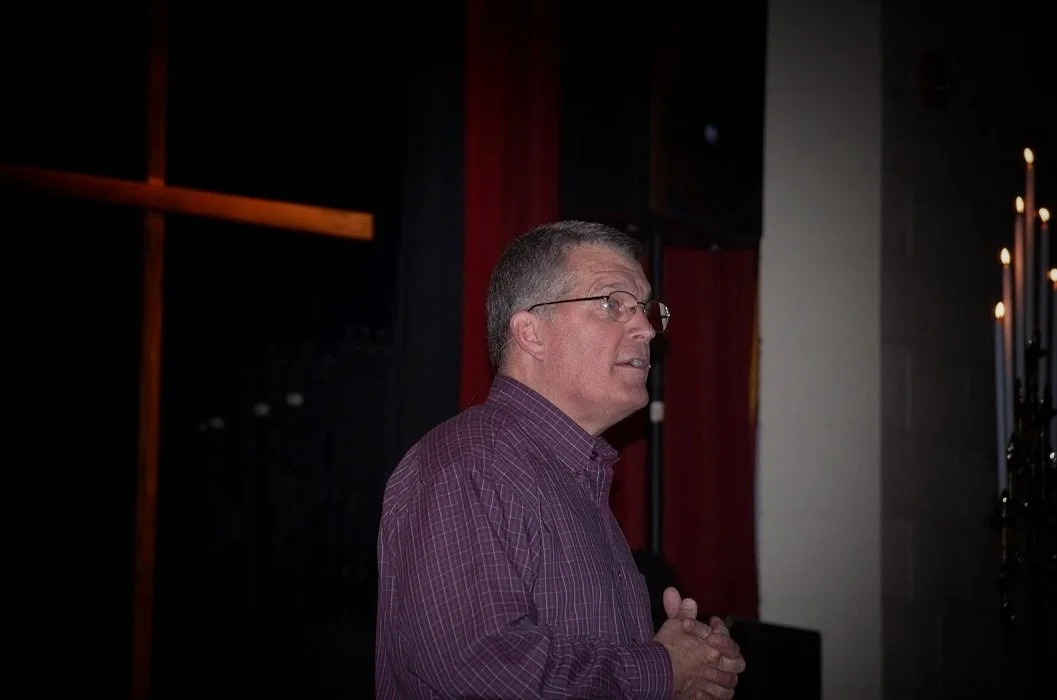
Take Don Windmiller for example. I cast a big shadow. Now, you can't really see it here because of all the lighting, but. But I cast a shadow. It is a form of me. It's not the real me. Bu it is near. If you put the sun behind me, it will cast the shadow before me, right? You'll see my shadow. You see me coming, my shadow would be coming first. If you put the sun in front of me, my shadow then is behind me.
So when my granddaughters, Harper and Avi see me coming with these shadowy, outstretched arms, they're not fearful because they know that the real thing is coming. To give them a great big hug, to love them.
It's not a perfect illustration, but here's the picture. In the Old Testament, they had sacrifices. They were temporary sacrifices. They were sacrifices pointing to the substance, Jesus Christ and the cross of Calvary and the resurrection of Christ to prove his power over the grave. When Christ, the real thing came, the shadow was now behind, no longer necessary.
"these are the shadow of the things to come, but the substance belongs to Christ," (Colossians 2:17)
The real thing, the substance was Jesus Christ. So, the old covenant in its law and with its sacrifices, they were incomplete to bring total cleansing of sin. That's why it says in verse one,
"it can never be the same sacrifice that are continually offered every year make perfect those who draw near." (Hebrews 10:1)
It can never. Those Old Testament sacrifices could never make perfect those who would draw near. Now this word perfect doesn't mean maturity makes them perfect and mature. But this word perfect here means to come to a full end, a full completion. The temporary sacrifices in the Old Testament could never complete the worshiper’s full qualification to come into the presence of God.
The Israelites could never go into the holy of holies. Once a year the high priest could go into the holy of holies, but he was the only one that could and present the sacrifice year after year. And that curtain between the holy place and the holy of holies that we've talked about was saying, not yet, you can't come into my presence yet. That curtain represented Christ between man and God. Only the high priest could come once a year.
However, when Christ came and died on the cross, what happened to that curtain? It was rented in two from top to bottom. And because of that, through Christ, God was now saying, now you can enter, now you can come into my presence. These Old Testament sacrifices were made repeatedly, year after year. They could never take away sin.
If they could completely remove sin, as it says in verse two,
"then they would have ceased. They wouldn't have ceased to be offered since the worshipers, having once been cleansed, would no longer have any consciousness of sin." (Hebrews 10:2)
So if they were not complete, if that's all that was necessary, then their conscience would be clear. But it wasn't, was it? It wasn't complete, it wasn't perfect, it was temporary. Every repeated sacrifice showed the deficiency of these Old Testament sacrifices. So, the offerings year after year were offered by imperfect priests for an imperfect sacrifice and could never give a clear conscience.
Look at what Albert Barnes in his commentary says about this word conscience.
"The rendered conscious here is not meant that he who has pardoned would have no consciousness of being a sinner, or that he would forget it, but that he would have no trouble of conscience, that he would have no apprehension of future wrath. The pardon of sin does not cause it to cease to be remembered. The remembrance of it will humble us, it will humble a man, and he will serve to exalt his conceptions of the mercy of God and the glory of the atonement. But it will no longer overwhelm the mind with the dread of hell" (Albert Barnes)
When we accept Jesus Christ as Lord and Savior because of his work on the cross. We don't have to fear the wrath of God anymore. We don't have to be afraid of His wrath.
"Therefore there's no condemnation for those who are Christ Jesus." (Romans 8:1)
So when you accept Christ, we no longer must fear hell. We no longer must fear the wrath of God. However, we still, as believers, are sensitive to sin. Paul was sensitive to a sin. We studied that when we studied in Romans.
In Romans 7, Paul battled between the flesh and the spirit living within him. In Romans 7:24,
"Wretched man that I am, who will deliver me from the body of death, thanks be to God through Jesus Christ our Lord. So, then I myself serve the law of God with my mind, but with my flesh I serve the law of sin." (Romans 7:24-25)
So just as there is pain in our body when we have a disease, or when we're driving on our logging road on our property and turning around on the little tractor, and we hit the side of the ravine, and the tractor throws us off into the ravine, down about 20ft and hit a tree with our head and our shoulder. We say, I shouldn't have done that. (my experience)
That hurts. And as a result, I'm going to have to have a shoulder replacement. So, our bodies with pain tell us there's something wrong with our body. So also, it is with the guilt of sin. Guilt is a warning system.
It says I've done something wrong. I've offended the holiness of God. It's something that I shouldn't do. It's like that light on the dashboard of your car. That engine light or oil light.
And it suddenly comes on and starts flashing. It says there's something wrong with your car. And if you don't stop and get it fixed, the car will stop - forever. And that's what happens with guilt. Guilt is a warning system that God puts within us to say there's something wrong.
You need to deal with it. David saw that. He knew that the sin with Bathsheba and his murdering of her husband Uriah. We find in Psalm 32, verses 1 to 5, he said,
"Blessed is the one whose transgressions are forgiven, whose sin is covered. Blessed is the man against whom the Lord counts no iniquity, in whose spirit there is no deceit. Happy is the guy who's been forgiven. For when I kept silent, my bones wasted away through my groaning all day long. For day and night your hand was heavy upon me. The strength was dried up as by the heat of summer. (We don't deal with our sin we try to cover it up. We. We don't acknowledge it. God's hand stays heavy on us. He applies that guilt to say; you need to deal with this). Then he said, “I acknowledged my sin to you and did not cover up my iniquity. I said, I will confess my transgressions to the Lord, and you forgave the iniquity of my sin." (Psalm 32:1-5)
In the NIV, it says, “and you forgave the guilt of my sin." (Psalm 32:5 NIV)
When we confess, God is faithful and just to forgive us and to cleanse us from all unrighteousness. (I John 1:9). He wants to do that. He is a merciful God. He wants to be merciful. He's just and He's Holy. However, our sin must be delt with. But he's merciful and he want to provide forgiveness and a way into His presence.
Look at verses three and four, and it says,
"but in these sacrifices, there is reminder of sins every year. For it is impossible for the blood of bulls and goats to take away sin." (Hebrews 10:3-4)
These sacrifices were done every day, and once a year on Yom Kippur, the day of Atonement, that sacrifice that the high priest would take into the holy of holies and offer sacrifice year after year. But he could never take away. Here it says, could never “take away” sin. It only covered sin.
This word “take away” is literally to take off, to remove. It's the same word that's used when Peter cut off the ear of the servant of the high priest in the Garden of Gethsemane. He cut it off, he removed it. That's exactly what it's referring to. But it's saying these animal sacrifices could never take away sin.
They were only temporarily covering. Hebrews 9:22 says,
"without the shedding of blood, there's no forgiveness of sin." (Hebrews 9:22)
So why blood? Pastor David explained that last week, and he mentioned that blood is mentioned 474 times in the Bible, 26 times in the book of Hebrews.
So it's important. Leviticus 17:11 says, “for the life of the flesh is in the blood, and I have given it for you on the altar to make atonement for your souls. For it is the blood that makes atonement for life." (Leviticus 17:11)
When Brian and I had open heart surgery, kind of major surgery, they had blood on hand units of blood just in case we needed a blood transfusion. So, without blood, there's death. Jay reminded us of a few weeks ago, in Genesis chapter three, when Adam and Eve had sinned and God walking in the garden, he said they were hiding. He said, why are you hiding?
Because we're naked. God said, why are you naked? Because we ate from the tree. They were guilty, and so God had to sacrifice an animal to make the skins to cover their shame and their guilt. There had to be a substitute for their sin.
The shedding of blood is important; God instituted a sacrificial system for the people to understand a sacrifice of blood had to be made. However, the sin to be removed by blood and goats were insufficient. Jesus Christ is our better, once for all substitutionary sacrifice. He is the one who doesn't cover sin. He takes it away. He removes it forever, taking away our guilt and shame, covering it with his righteousness, the righteousness of Christ.
Romans 6:23 says, “the wage of sin is death, but the gift of God is eternal life through Jesus Christ our Lord."
The payment for our sin, God is saying, is death. Eternal separation from him.
We will all die. But where are we going to go? We sang about it. Where are we going to go after death? One of two places – Hell or Heaven.
How do we get to heaven? How are our sins dealt with? God gives us a gift, and it's through Jesus Christ. The payment for sin is death. Eternal separation from God.
But Jesus Christ paid that debt. He was our substitute to remove sin. What an incredible gift. We can't even hardly get our minds around that, right?
It's so wonderful, so incredible because we think, well, we've got to earn it. We've got to pay for it. We can't. We're not good enough.
All our works are like filthy rags. The Bible says. Ephesians 1:7 says, "in him we have redemption through his blood, the forgiveness of our trespasses according to the riches of his grace."
I John 1:7 says, “but we walk in the light, as he is in the light, and we have fellowship with one another. And the blood of Jesus, his Son, cleanses us from all sin." (1 John 1:7)
Let’s look at verses now, five through eight.
2. “The sacrifice's shortcomings”.
"Consequently, when Christ came into the world, He said, “sacrifices and offerings you have not desired, but a body have you prepared for me in burnt offerings and in sin offerings you have taken no pleasure. Then I said, behold, I have come to do your will, O God, as it is written of me in the scroll of the book. And when he said above, you have neither desired nor taken pleasure in sacrifices and offerings and burnt offerings and sin offerings. These are offerings according to the law." (Hebrews 10:5-8)
This preacher here, the author of Hebrews in verses 5 through 8 is quoting Psalms 46:8. He's quoting this messianic prophecy in Psalms 46:8. Look at it.
"In sacrifice and offerings you have not delighted, but you have given me an open ear. Burnt offerings and sin offerings you have not required. Then I said, “Behold, I have come. In the scroll of the book, it is written of me I delight to do your will, O my God, your law is within my heart." (Psalms 46:8)
Now David, as he writes this, is speaking of himself, but also very clearly. This is a Messianic prophecy. This is a pre incarnate conversation between Christ the Son of God and God the Father. What an incredible thing that's going on here.
Jesus is saying that my ears are open. I'm listening to you, God, and I will obey you.
More than these temporary sacrifices, God wanted obedience. These sacrifices were just a picture of the ultimate once for all sacrifice that would take away sin, but he wanted our obedience.
1st Samuel 15:22 says, "Behold, to obey is better than a sacrifice." (1 Samuel 15:22)
David also understood this. In Psalm 51: 16 and 17…
"for you will not delight in sacrifices, or I would give it to you and not be pleased with burnt offerings. The sacrifices of God are a broken spirit and a broken and contrite heart. O God, you will not despise." (Psalm 51:16-17)
A thousand years before Christ came, David knew in his heart in a way that was only revealed to him through the Holy Spirit, that God wanted more than just sacrifices. He wanted our hearts. He wanted us to believe in him and trust him by faith. It was credited to Abraham as righteousness because of his faith, not because of what he did.
God was displeased with the worshipers because they were worshiping ritually rather than by faith. It was a ritual thing for many of them. They just came and did it. We must be so careful when we come and worship at Gateway that we're just not doing it in a ritual way, doing it by rote. Rather, we are giving God our hearts in the worship.
Verse 5, God was preparing a perfect sacrifice.
"But a body have you prepared for me?" (Hebrews 10:5)
This is a reference to the Messiah, bodily entering the world. This is the incarnation that he's speaking of here in verse 5,
Colossians 2:9 says, “for in him the whole fullness of deity dwelled bodily fully God, fully man." (Colossians 2:9)
Philippians 2:7 says, “the son of God emptied himself by taking on a form of a servant being born in the likeness of men." (Philippians 2:7)
In John 1:14, "the Word became fresh and dwelt among us, tabernacles among us. And we have been seeing his glory, the glory as the only Son from the father, full of grace and truth."
God was saying, I'm not fully pleased with these burnt offerings. They're incomplete. They are pointing to the complete. They are pointing to the better. But when Jesus came, when John the Baptist baptized him, the heavens opened up, the dove descended, the Holy Spirit descended upon Christ.
And we heard the voice of God in the clouds thundering, saying, this is my beloved Son, in whom I am well pleased.
That's the sacrifice that God was well pleased with. So, in both Psalm 47 and in Hebrews 10:7, he says,
"Behold, I have come. In the scroll of the book, it is written of me." (Psalm 47 / Hebrews 10:7)
Jesus is the fulfillment of the word of God. He is the fulfillment of the Torah, the first five books of the Old Testament, Genesis, Exodus, Leviticus, Numbers, Deuteronomy, but also the entire Scriptures. Because scriptures say that all scripture is God breathed. So, Christ is the fulfillment of the book. He is all about the book. He is the redemption which flows throughout the entire Bible.
The Jews, were people of the book. They should know that God had a plan. In John 5:46, Jesus said to them, “for if you believe Moses, you will believe me, for he wrote of me."
Jesus is saying, I mean, it’s right there, guys, don't you see it?
And we as believers in Christ - we are people of the Book.
Here at Gateway, Gateway Bible Church it’s in our name. We are people from the book. In a world where truth is relative, the Bible is a roadmap to absolute truth. We don't have time to go into the apologetics of it. A message for another time.
But the Word of God says, in Hebrews 4:12, "for the word of God is living and active, sharper than any two-edged sword, piercing to the dividing of soul and spirit, of joint and marrow, and discerning the thoughts and intentions of the heart." (Hebrews 4:12)
2nd Timothy 3:16. “All Scripture is God breathed, breathed out by God, and is profitable for teaching and reproof and correction and training in righteousness." (2 Timothy 3:16)
John 17:17 says, "Sanctify them in truth. Your word is truth." (John 17:17)
1 Thessalonians 2:13 “and we also thank God constantly for this, that when you received the word of God which you heard from us, you accepted it not as the word of men, but as what it really is, the Word of God which is at work in you believers."
John Stott
"we need to repent of the haughty way in which we sometimes stand in judgment upon Scriptures and must learn to sit humbly under its judgment instead. If we come to the Scriptures with our minds made up, expecting to hear from it only the echoes of our own thoughts and never the thunderclaps of God, then indeed he will not speak to us, and we shall only be confirmed in our own prejudices. We must allow the Word of God to confront us, to disturb our security, to undermine our complacency and to overthrow our patterns of thought and behavior." (John Stott)
The Word of God will disturb our securities. It will mess you up, if we go through it, it will convict us. It will change us, it counsels us, it comforts us, it challenges us.
Like Rick said a couple weeks ago in his message, “we need to preach the gospel to ourselves every day”.
We need to preach the gospel to ourselves. We need to humble ourselves before God and through his word and let him teach us, let him change us.
Look at verses nine to ten,
3. The Savior's selfless sacrifice.
“Then he added, behold, I have come to do your will. He does away with the first to establish the second. And by that will we have been sanctified through the offerings of the body of Jesus Christ, once for all." (Hebrews 10:9-10)
The preacher here in Hebrews applies this directly to Christ. Christ is saying, I've come to do your will. He's quoting Psalms 48,
"I delight to do your will, O my God. Your law is written in my heart." (Psalms 48)
In John, chapter 6, verse 38 to 41 - "For I have come down from heaven not to do my will, but to do the will of him who sent me. And this is the will of him who sent me, that I should lose nothing of all that he has given me but rise on the last day. For this is the will of my Father, that everyone who looks on the Son and believes in him should have eternal life. And I will raise him up."
Before Christ arrest in Gethsemane, we see Christ's humanity on display.
Pastor talked about this also last week. In the great sweat drops of blood that rolled down his face and in incredible human agony, Jesus said,
"father, if it be your will, remove this cup from me. Nevertheless, not my will, but yours be done." (Luke 22:42)
The preacher is saying here in verse nine, "he does away with the first, in order to establish the second." (Hebrews 10:9)
Simply, the first is the Old Testament sacrifices and offerings. He did away with that to establish the second Christ, the fulfillment of the law. Jesus death on the cross signaled that the old was gone. The old priesthood was gone.
The new covenant in his blood is here.
Verse 10 says, “and by that will we have been sanctified through the offering of the body of Jesus Christ once for all." (Hebrews 10:10)
By that will. What will? God's will and Christ's will together.
It was God's will that he sent his Son. It was Christ's will that he was obedient to God the Father, so that he could offer himself as an atonement, as a substitutionary atonement for us, for you, for me. Don't think in terms of the whole world, which he did, but think about it personally… Jesus = (Yahweh saves). Christ = (the Anointed One).
It's more than a name and a title. It points to his mission and to his divine authority. For you and for me. The word “offering” simply means that he offered Himself. He died on the cross for you and for me.
Acts 4:12 "and there is salvation in no one else. There is no other name under heaven given among men, by which we must be saved." (Acts 4:12)
He is the only way. Jesus said to his disciples and said to Thomas that asked the question.
"I'm the way, I'm the truth, I'm the life. No one comes to the father but by me." (John 14:6)
There's not another way. There are not many ways to God. There's only one way, and it's through Christ. Why would God sacrifice His own Son and say, oh, and you can also come to me in other ways also.
He wouldn't do that. By his will we “have been sanctified. Past tense. The preacher saying, here have been, are now already sanctified. We have been made perfect.
When you accept Christ as Lord and Savior, God sanctifies you through the work of Christ on the cross. It is complete and positionally we are sanctified. We have that eternal life set in heaven, an inheritance in heaven kept for us by God there because of the work of Christ.
First Corinthians 6:11 “and such were some of you. But you were washed, you were sanctified, made perfect. You were justified in the name of the Lord Jesus Christ and by the Spirit of our Lord."
So, it's a done deal when you accept Christ as Lord and Savior. We are sanctified; we are made holy. We are set apart, Positionally, and God keeps that in heaven as an inheritance for us. However, we still are sinful beings, right?
However, we still have this old flesh, so we are also being sanctified.
Second Corinthians 3:18 "and we all, with unveiled faces, beholding the glory of the Lord, are being. We are growing in maturity, being transformed into the same image from one degree of glory to another. For this comes from the Lord, who is the Spirit."
When I was conceived, Don Windmiller, the son of Jackie and Lee Dean Windmiller, came into existence. It was all of me. When I came through that birth canal and came out into this world, I began to grow physically as I grew in the womb, and I began to grow mentally.
When we were born again, when we accept Jesus Christ as Lord and Savior, we were sanctified, we were made holy, we were set apart, we were justified. Justified is a legal term that God has made us, right? He has delivered us from the penalty of sin, right?
John MacArthur on sanctification…
“Now we're positionally holy, but how are we doing practically? Paul says to the Corinthians, you're holy, but cleanse yourself from all filthiness. So positionally you're terrific, but practically you're hurting, And God's will, and God will be that we be practically holy to match the position. But he is talking here about position here”. that we are positionally holy. We have eternal life.
God has given that to us. We haven't earned it. We haven't paid for it because all our work is filthy rags. So, you can't earn salvation, you can't pay for it. It's a gift of God by grace, through faith.
But when we are born again, God declares the guilty sinner to be righteous. And God makes the believing sinner righteous when he sanctifies us. God sees me through Christ's righteousness.
We can now enter this holy presence of God through the blood of Christ. Our sins are removed. The robe of righteousness has been given to us.
First Corinthians 1:30 "it is because of him that you are in Christ Jesus, who has become for us wisdom from God, our righteousness and holiness and redemption."
It is Christ's work. God gives it to us. Romans 3:22. “The righteousness is given through faith in Christ Jesus to all who believe, trust him as Lord and Savior."
Isaiah 61:10 says, “he clothed me with the garment of salvation and wrapped me in the robe of righteousness."
And So I am covered by the blood.
And so when God looks at me, he first sees Christ. He first sees his sacrifice, his blood shed for me and the righteousness that is Christs’, given to me. And God sees that. And I am welcome into his presence.
This forgiveness of sin, through Christ death on the cross, and It's finished. It's complete. It's done. Once for all.
The Scripture says, “once for all”. We sang about it. Once for all. The writer of Hebrews repeats the theme repeatedly. Once for all, 35 times in scripture you see the word once for all.
Three times here in the book of Hebrews. Once for all. It's finished. Never to be done again. no other sacrifice needed.
So if you say, well, God can't forgive me. He can't forgive this sin that I've done. Well, then, do we nail him to the cross again or is there another sacrifice? No, this is the once for all sacrifice. Jesus has done it.
He's enough. And he will forgive any sin, we the sinner that comes to him and repents of that sin and takes Jesus Christ to be his personal Lord and Savior.
So, in closing, what do we do with Jesus? There's a lot of theology here, but what do we do with it practically?
1. Realize that God loves us.
John 3:16 “God so loved the world that he gave his only Son that whoever believes in him will not perish but have everlasting life”.
2. We are all separated from God.
recognize that… Romans 3:23 “All have sinned and fallen short of God's glory”
fallen short of his standard. I'm a sinner. I'm separated from Him.
3. Payment for my sin is death.
You do a job; you get paid for it. You've earned some money for doing a job. Well. What we earn for sin is death.
Romans 6:23a “The wage of sin is death” Eternal separation from God.
4 God gives eternal life through the death of His Son
But in verse 6:23b “… God gives eternal life through Jesus Christ”.
5 We repent and believe the Gospel
“Repent and believe the Gospel." (Mark 1:15)
Repent and believe that Jesus died on the cross, that he rose again from the dead to prove his power over the grave, and that he's seated at the right hand of God the Father right now and offers eternal life to us. We sang about that. The wonder and the glory of heaven. This place is not our home. We're not citizens here.
We're just passing through as Believers in Jesus Christ, we are citizens of heaven, and we can look forward to that.
Ephesians 2, 8, 9 “for by grace are you saved through faith, that it's not of your own doing, it's a gift of God, not a result of works, so no one may boast"
So nobody can boast about it. So, in Romans 10, it says that we need to confess with our mouth that Jesus is Lord. How do you get this eternal life?
You believe that Jesus Christ died on the cross and rose again from the dead. You confess that with your mouth and believe it in your heart that God raised him from the dead and you will be saved.
Romans 10:9-10 because, if you confess with your mouth that Jesus is Lord and believe in your heart that God raised him from the dead, you will be saved. 10 For with the heart one believes and is justified, and with the mouth one confesses and is saved.
God, I believe it in my heart. I confess you with my mouth. I believe that you are the Lord and Savior of the world and you are the Lord and Savior of my life, that you died for my sin.
6. Begin a new life – walk with Christ and His ways
And I believe. And because of that, we then need to begin a new life and walk with Christ in His ways. You just don't accept Christ and now everything's fine, you do whatever you want to do.
It's a new life, it's a new direction. Repenting is turning from this direction to the way of Christ. It's a new life, it's a new direction, it's a new obedience, it's a new joy and wonder that's happening in our lives.
Colossians 2: 6 -7 "so then, just as you receive Christ as Lord, continue to live your lives in him, rooted and built up in him, strengthened in the faith as you were taught, and overflowing with thankfulness."
So as I have accepted Christ, now I want to put my roots deep into him, into his word, to understand more of who he is and how he wants me to live and reflect his glory and have his joy,
“Restore the joy of my salvation” David said.
as we confess sin there should be overflowing thankfulness and gratitude for what God has done for me.
Maybe you online or anybody here in this room haven't made that choice yet. That's the practical application of what the preacher is saying here in Hebrews chapter 10. The old sacrifices were just pointing to Christ because God wants us all to know Christ and to live with him forever.
Pray with me, Father. I pray that if there's anybody online or anybody in this room that hasn't made that faith trust in you yet, that they would do it today, Lord.
Jesus, we would say, father, I know that you love me and that you've got a plan for me. And you sent your son to die on the cross for my sin and that you raised him from the dead. I believe that. I accept that by faith. Thank you for this grace gift that you've given me.
And as I confess you, Lord Jesus, that you are my Lord and Savior. And I believe it in my heart, Lord, I want to walk with you. I want to learn more from you. I want to have a life. Just go deep into your life and to grow in you.
And I thank you for saving me. In Jesus name, amen.